
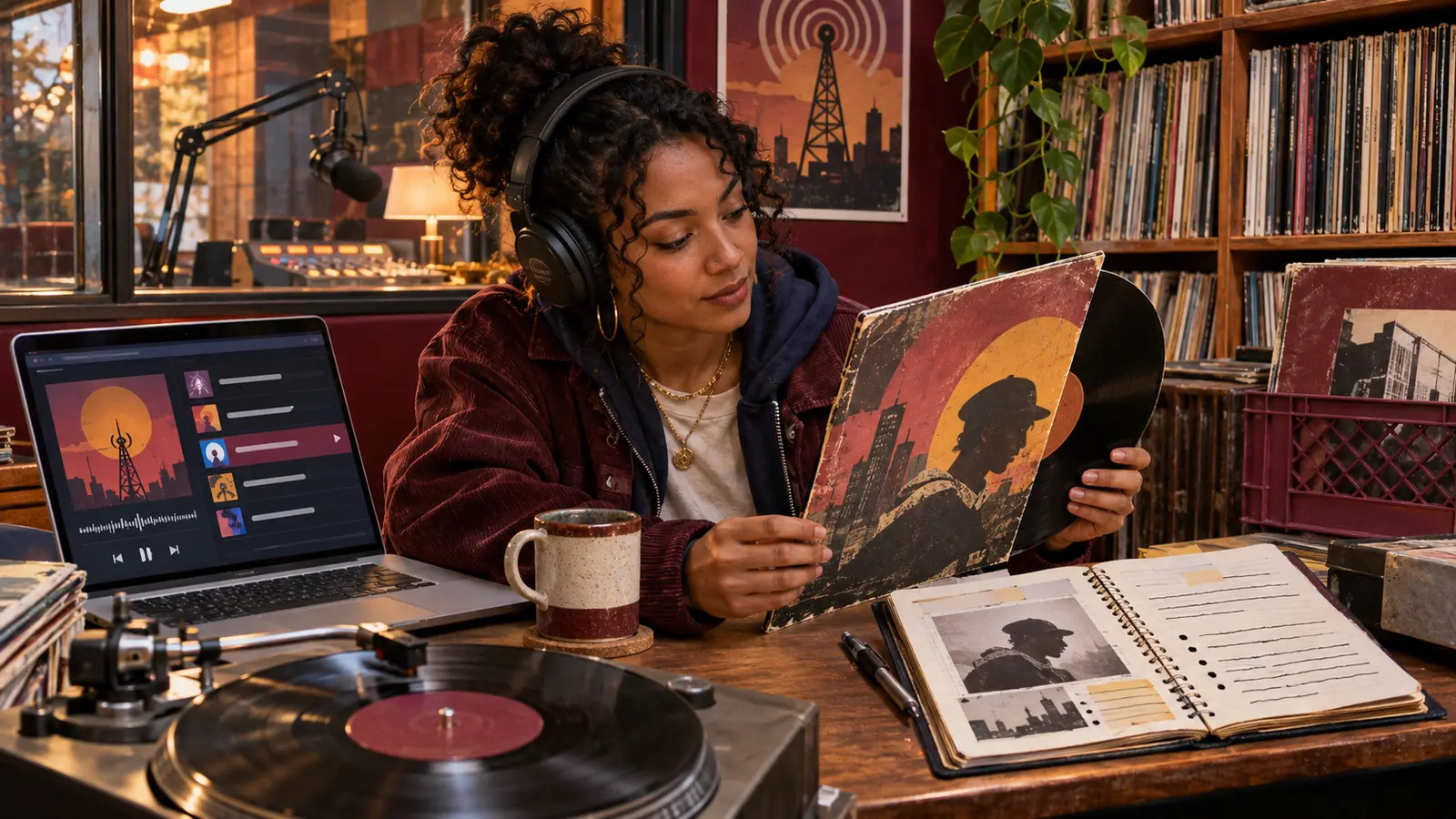
An archived radio-show playlist can turn one unfamiliar song into a grounded discovery trail. Unlike an anonymous recommendation tile, it can preserve the date, show, host, sequence, artist, track, release, and neighboring selections that gave the song context.
Not every station publishes complete playlists, and a logged entry can contain a typo or planned song that changed on air. Treat the playlist as a lead to verify, not proof of popularity, airplay totals, endorsement, ownership, or listener count.
Begin with one identifiable episode
Choose a station or show whose public archive names the program and date. Save the page URL, episode date, approximate time, and host or show name. Starting with one broadcast keeps the trail small enough to check.
Spinitron describes public station pages with browsable playlist archives organized by date, DJ, or show. It also notes that playlists can be entered live, before, or after a show. That explains why a dated page is useful and why it still needs verification.
Read the sequence, not only one row
Look at two or three songs before and after the unfamiliar track. The sequence may reveal a regional set, producer thread, stylistic bridge, label feature, new-release block, or contrast chosen by the host. Record what is visible without guessing the host's reason.
If a timestamp exists, compare it with an authorized archive or current release. If no audio archive exists, use the playlist only as a track list and continue through official artist or label pages.
Verify the recording identity
Confirm the exact artist name, track title, featured artists, mix or edit, release title, label, and release date where possible. Search for an official artist page, label catalog, distributor page, or reliable credit database. Watch for artists who share a name and for clean, live, remix, or remastered versions.
MusicBrainz distinguishes a recording from a release and a release group, and its artist relationship guide recommends attaching credits to the most specific known entity. That distinction helps when one song appears on several editions or platforms.
Listen past the logged spin
Play the complete track from an authorized source, then sample one contrasting release by the same artist. Note one specific musical detail and one question. Avoid treating a single radio appearance as a career ranking.
For a more focused second listen, use the countermelody listening exercise on a section with multiple melodic layers. The goal is to turn discovery into attention, not to manufacture instant judgment.
Follow one verified relationship
Choose only one next path: the featured artist, producer, label, show host, local scene, or another track in the same sequence. Verify that relationship before adding it to your notes. A short confirmed trail is more useful than twenty tabs with no source.
If the show regularly documents local or independent music, review another episode from a different week. Compare what changes without assuming the archive represents the entire scene.
Keep a small discovery record
Use columns for station, show, episode date, playlist URL, logged artist, logged track, verified recording, official listening link, source checked, listening note, and next relationship. Add a status such as verify, listen, keep, or stop.
Preserve spelling corrections separately from the original listing. If you contact a station about an error, be concise and provide the episode date and source; do not demand a correction based on an unverified assumption.
Respect the archive's limits
Do not scrape private data, repost an entire playlist archive as your own, or imply that a station supports a service you are promoting. Honor access rules and link back to the public source. If the playlist has no stable public link, keep a private note instead of reconstructing it from memory as fact.
Continue through The Signal for other careful discovery methods, including label catalogs, producer credits, college-radio charts, opening-act lineups, live sessions, DJ sets, and record-store programming.
References: Spinitron, Features for stations and DJs; Spinitron, Calendar concepts; MusicBrainz, Artist Relationship Guide for Artists. Checked November 4, 2026.
Press Play above to hear IHHR or visit the official Live365 station page.