
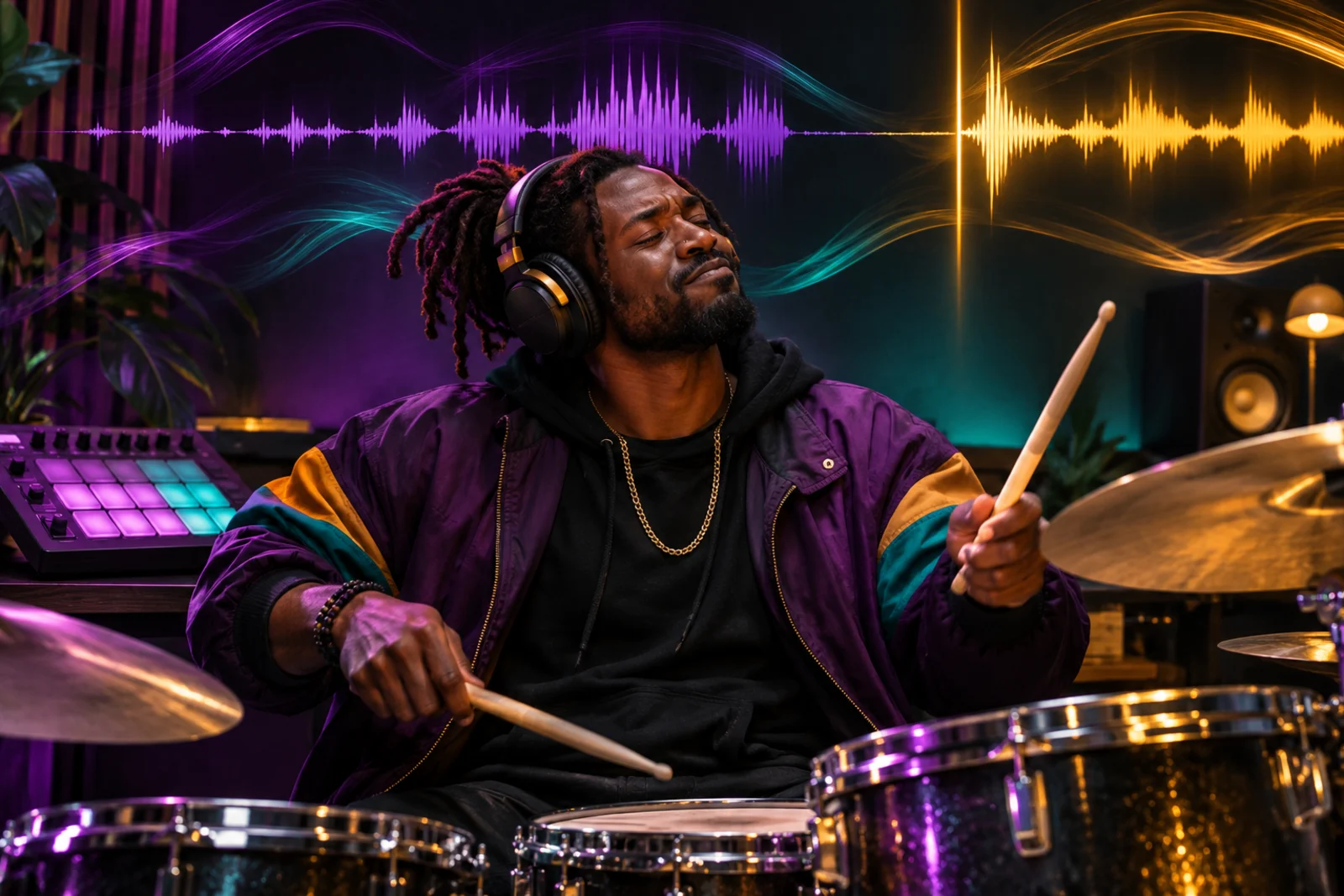
A drum fill is a short variation that can lead into a new phrase or section. In rap and R&B, it may be a tom run, snare pickup, kick burst, percussion flourish, cymbal swell, chopped vocal accent, or even a deliberate gap. Complexity is not the test. The useful question is whether the event departs from the established groove and helps prepare or mark a boundary.
Not every unusual hit is a fill. A recurring syncopation may be part of the main pattern, and a one-time production effect may signal a lyric or sound-design moment rather than a structural change. Listen before naming the event.
Establish the base groove first
Follow four or eight measures before the suspected fill. Tap a steady pulse and note where the kick, snare or clap, hi-hat, and other recurring percussion usually land. The IHHR drum-programming listening guide can help separate the layers without guessing which machine, sample pack, or performer created them.
Write a compact pattern map using counts or boxes. You do not need formal notation. The goal is to know what “normal” sounds like in this section so the variation becomes clear.
Count the larger phrase
Count measures in groups of four or eight while following the vocal phrase, harmony, bass cycle, or sample loop. Many fills occur near the end of a phrase, but do not assume every fourth or eighth measure contains one. Mark the actual sound and the actual boundary.
If the track uses an irregular phrase, pickup, stop, or overlapping vocal entry, keep counting the pulse through it. The fill can begin before the final measure or extend across the downbeat of the new section.
Listen one measure before the change
Focus on the last full measure before the verse, hook, bridge, breakdown, or return. Note which recurring hits disappear and which new attacks appear. A fill may add density, move across drum sounds, repeat a faster figure, shift accents, or create suspense by removing the expected backbeat.
Describe the audible sequence neutrally: “the regular kick and clap stop, three lower drum hits descend, then the hook enters with a crash.” Do not infer an acoustic drum kit, a live take, or a specific plug-in unless reliable production information confirms it.
Separate the fill from the arrival
The fill prepares the boundary; the first downbeat, crash, bass entrance, vocal stack, or new harmony may announce the arrival. Mark both moments. If you label the arrival hit as the entire fill, you can miss the short setup that made it feel strong.
Replay the passage and mute by attention. First follow only the fill, then only the first beat of the new section. Ask whether the fill points forward, interrupts the old groove, or simply decorates its ending.
Compare three transitions
Find three boundaries in the same recording. One may use a busy fill, another a single pickup, and another silence. Compare their lengths, sounds, positions, and the sections they introduce. Repetition can turn a particular fill into a recurring signpost; variation can make one transition feel more important than the others.
Do not rank the most complex transition as the best. A one-beat gap can create more contrast than a dense run. Describe how the choice affects expectation, space, and the entrance that follows.
Track the vocal and bass relationship
A rapper may continue across the drum fill, pause before it, or begin the next phrase early. A singer may hold a note while the drums move underneath. The bass may stop with the groove, mirror the fill, or land only on the new section. Mark each layer separately so the drum event does not erase the rest of the arrangement.
Use timestamps and neutral descriptions instead of copying lyrics. A note such as “1:12, snare burst under the end of the vocal phrase; hook begins at 1:14” is enough to revisit the evidence.
Run a six-pass fill check
- Groove: map the recurring pattern before the boundary.
- Phrase: count the larger group of measures.
- Departure: identify what changes or drops out.
- Length: mark where the variation starts and ends.
- Arrival: separate the fill from the new section's first event.
- Role: describe what the transition prepares or emphasizes.
Try the exercise during the IHHR live stream. If a transition contains no clear fill, record that result. Accurate listening includes recognizing a straight cut, sustained sound, or silence instead of forcing every boundary into the same label.
References: Oak National Academy, Music curriculum resources on drum fills and section transitions; Ithaca College, Popular Music Pedagogy resources. Checked November 16, 2026.
Press Play above to hear IHHR or visit the official Live365 station page.