
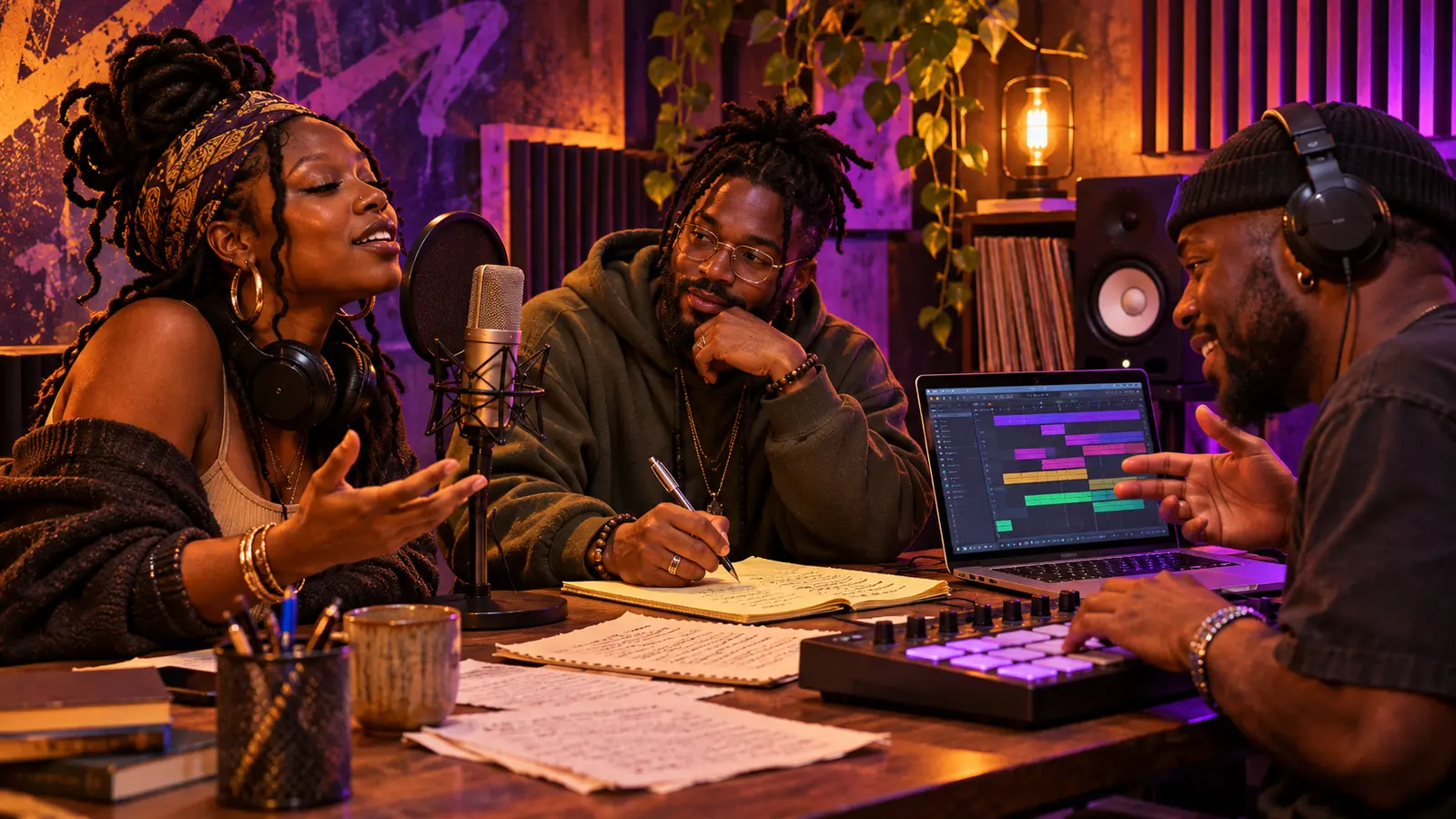
A productive co-writing session needs more than talented people in one room. It needs a shared target, room for each contributor to work, and a record of what the group decided. The goal is not to force creativity into a spreadsheet; it is to remove avoidable confusion so the team can listen, write, revise, and leave with the same understanding.
This workflow does not determine copyright ownership, contractual rights, publishing administration, payment, or royalty shares. Confirm the real agreement with every contributor and get qualified professional advice when the facts require it. Do not record anyone or feed their voice, lyrics, likeness, or private files into an AI system without informed permission.
Send a one-page session brief
Before the session, name the project, intended performer, general genre, emotional point of view, approximate song form, reference qualities, deadline, and the one result the team hopes to reach. A result might be a complete chorus and verse map, not an unrealistic promise to finish a release-ready master in two hours.
Include the confirmed people, location or meeting link, start and stop time, technical needs, and what each person should bring. Berklee's collaborative-songwriting curriculum treats setting objectives, dividing tasks, choosing paths, decision-making, coauthor business issues, and technology-supported collaboration as connected parts of professional co-writing.
Define roles without trapping people in them
Start by identifying who is leading the brief, beat or instrumental, melody, lyrics, vocal demonstration, recording, and file capture. One person may hold several roles, and roles can change as the song develops. Say those changes aloud so a quiet contribution does not disappear from the record.
Use roles to create access, not rank. A producer can offer a lyric idea; a vocalist can reshape the form. The useful question is who owns the next decision and who needs to be heard before it is locked.
Open with boundaries and permissions
Confirm whether the session may be recorded, whether rough files may leave the room, whether remote participants can download them, and whether any generative tool is allowed. Identify samples, beats, melodies, demos, or prior lyrics that arrived before the session. Mark third-party material as unverified until its source and permission are known.
Have the ownership conversation early enough that nobody is surprised. IHHR's songwriting-split preparation guide provides a neutral checklist. Berklee's copyright guidance recommends a split sheet for each completed song so contributors can discuss ownership and decision rights; the actual shares must come from the contributors, not a default template.
Build a short agenda with listening time
Try five blocks: brief and boundaries, source listening, idea generation, structured drafting, and review. Leave breaks between intense vocal work. Do not fill every minute with talking. A group needs quiet passes to hear whether a phrase belongs in the song.
At the top of each block, name the question. “What must the hook make clear?” is more useful than “make it catchy.” “Where does the narrator's position change?” creates a checkable writing task. The song point-of-view map can help a rap or R&B team track who is speaking, to whom, and from what moment.
Capture ideas before judging them
Create an idea bank for titles, images, melodic shapes, rhythmic pockets, scenes, and unresolved questions. Label every voice memo and lyric draft with the session date and an owner-approved project name. Do not call an early fragment “final,” and do not silently delete an idea another contributor may want to revisit.
Then select against the brief. Ask which idea advances the emotional point, gives the performer a believable voice, and creates contrast between sections. Popularity predictions and algorithm guesses are not substitutes for an artistic reason.
Use a decision rule before disagreement
Agree whether decisions require consensus, a designated artist lead, or a producer recommendation with group confirmation. When two options survive, record both under stable names and set a later A/B review. Do not win a disagreement by exporting only your preferred take.
Write a short decision note: what changed, why, who approved it, and what remains open. Berklee's course description specifically includes decision-making and consensus among the pragmatic realities of collaboration.
Keep versions and contributions legible
Use a shared session folder with an original instrumental, lyric drafts, reference bounces, voice memos, and an approvals note. Name versions with date, project, section, and revision number. Preserve the incoming files unchanged and work from copies.
At each bounce, record the lyric version, beat version, key or tempo only if verified, guide vocalist, and missing elements. A filename such as “final2reallyfinal” cannot tell a later mixer which words everyone approved.
Close the session together
Play the current work once without interruption. Then confirm what exists, what still needs work, which files may be shared, who will make the next revision, and when the group will review it. Record provisional contributions and schedule the split conversation rather than assuming silence means agreement.
Send a same-day recap with links, not attachments scattered across private chats. Discuss general collaboration questions in the reviewed artist forum without posting unreleased audio, personal contacts, contracts, or somebody else's lyrics. Continue through The Signal for practical independent-artist workflows.
References: Berklee College of Music, Songwriting Collaboration; Berklee Online, Collaborative Songwriting; Berklee Online, How to Copyright a Song. Checked November 2, 2026.
Press Play above to hear IHHR or visit the official Live365 station page.