
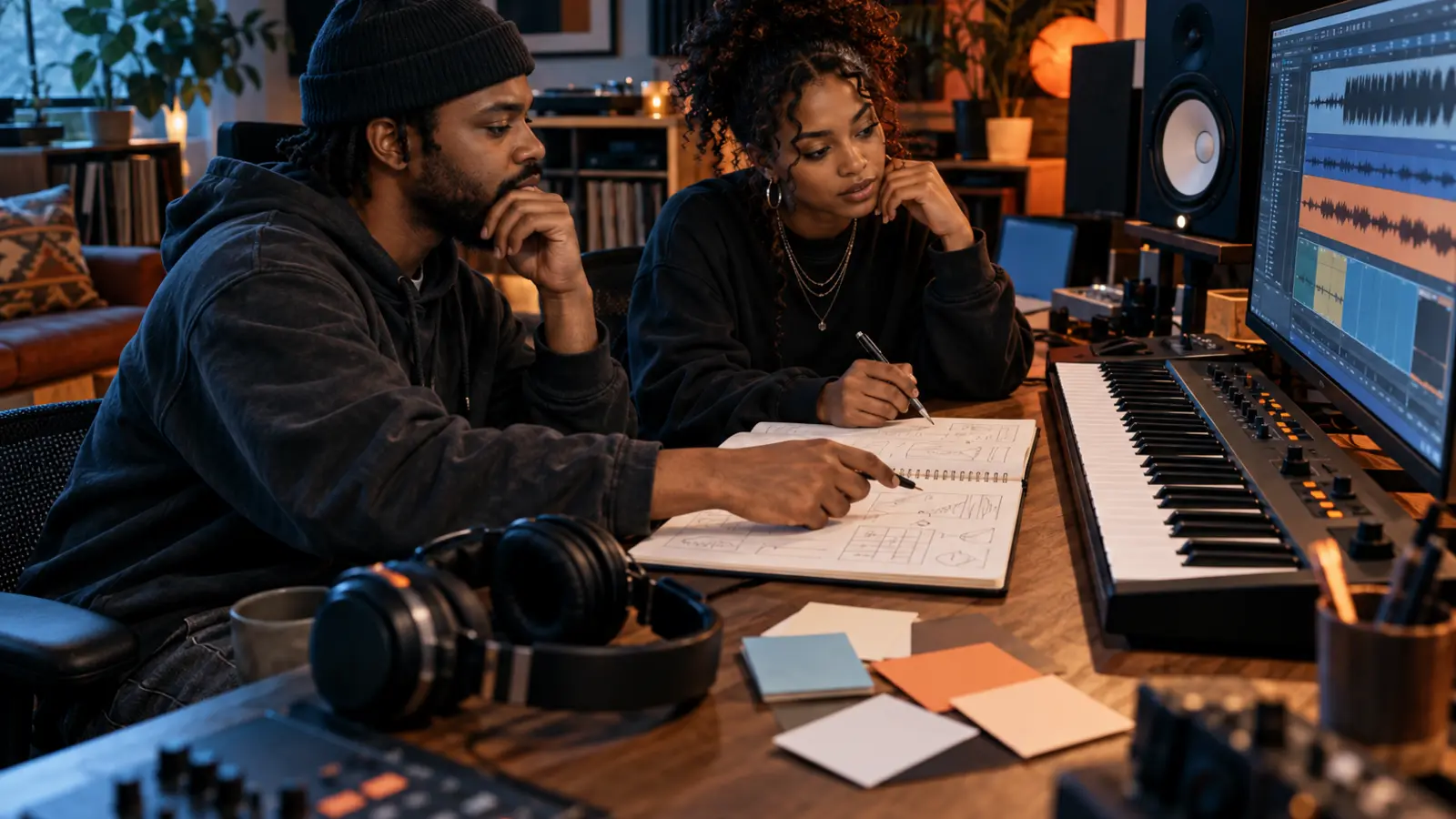
A reference track should help two creators talk about sound. It should not become an instruction to recreate somebody else's melody, lyrics, beat, sample, arrangement, or signature recording. A useful brief identifies the effect you want and leaves room for the producer to design an original route.
Begin by separating inspiration from specification. “Make it sound exactly like this record” shifts the burden onto imitation. “I want the drums to feel patient in the verse and urgent in the hook” gives the producer a creative problem to solve.
Start with the song's job
Write one sentence about what the new track must do. Is it a reflective opener, a tense storytelling record, a loose cypher performance, a melodic bridge between two songs, or a live-ready closer? Name the listener experience before naming another artist.
Add practical boundaries: target length, clean-version needs, featured performers, expected vocal density, live instruments, stems, delivery date, and the budget you can actually approve. If the scope and spend are still unclear, IHHR's paid campaign-planning page for goals and budgets can help frame the larger release decision; it does not guarantee streams, rankings, airplay, or listener results.
Use three references for three different reasons
Choose no more than three recordings and give each a single job. One may demonstrate drum movement, another vocal space, and a third the way energy changes between sections. Using one track for every instruction creates pressure to copy its whole identity.
- Reference A — movement: where the groove opens, tightens, drops, or turns.
- Reference B — space: how much room surrounds the lead vocal and important instruments.
- Reference C — arc: how the arrangement earns its largest moment.
Link to an authorized listening source and include timestamps. Do not send ripped files, isolated stems, or unreleased material you do not have permission to share.
Describe relationships instead of copying parts
Talk about contrast, density, motion, and function. “The kick leaves room after the first vocal phrase” is a relationship. “Use that exact kick pattern” is a copying request. “The bass becomes more active after the bridge” gives direction without supplying somebody else's notes.
The U.S. Copyright Office explains that copyright protects original expression rather than ideas, methods, or systems. That distinction is not a license to borrow protected musical expression, and this article is not legal advice. It is a practical reason to discuss the creative idea—tension, swing, negative space, gradual lift—while asking the producer for new expression.
Build a section map
Sketch the desired order with approximate bars or time, but label it flexible until the music proves otherwise. For example: four-bar texture, sixteen-bar verse, eight-bar hook, short reset, second verse, expanded final hook. Add what each section must accomplish rather than filling every second with production.
Mark one non-negotiable and two open decisions. A non-negotiable may be space for a long first verse. Open decisions might be whether the bridge removes drums or whether a harmony appears in the final hook. Producers need enough direction to begin and enough freedom to contribute.
Define the vocal relationship
State whether the performer writes before hearing production, writes to loops, freestyles structure, or needs a nearly complete arrangement. Estimate lead-vocal range and density without promising a musical key you have not confirmed. Note doubles, ad-libs, sung hooks, guest verses, and clean replacements that may need room.
If the creator uses generative tools during exploration, record those steps with the IHHR AI-music session-log workflow so later collaborators can distinguish human choices, tool outputs, versions, and final approvals.
Clarify originality and samples
Write that references are for communication, not reproduction. Identify any material already supplied by the artist and whether it is original, licensed, commissioned, or still awaiting clearance. Never tell a producer to “flip it enough that nobody notices.”
If a new sample, interpolation, or outside recording enters the work, stop and document the source before release planning continues. A vague file name and a memory of where it came from are not a rights record.
Agree on the handoff
- Confirm the brief and references in writing.
- Define the first delivery: sketch, loop, arranged demo, or near-final instrumental.
- Set the number and scope of revision rounds.
- Agree on fee, payment timing, producer credit, splits, ownership, and stem delivery.
- Name the person who approves the final production.
Keep actual deal terms and private files out of public posts. General collaboration questions can go to the reviewed IHHR artist forum, where new topics and replies are reviewed before publication.
A strong brief does not make every decision in advance. It creates a shared vocabulary, protects originality, and makes disagreement visible while changes are still affordable. Explore more practical craft guidance in The Signal, then listen live to IHHR for examples of arrangement contrast across independent records.
Source: U.S. Copyright Office, Ideas, Methods, or Systems, accessed October 14, 2026.
Press Play above to hear IHHR or visit the official Live365 station page.