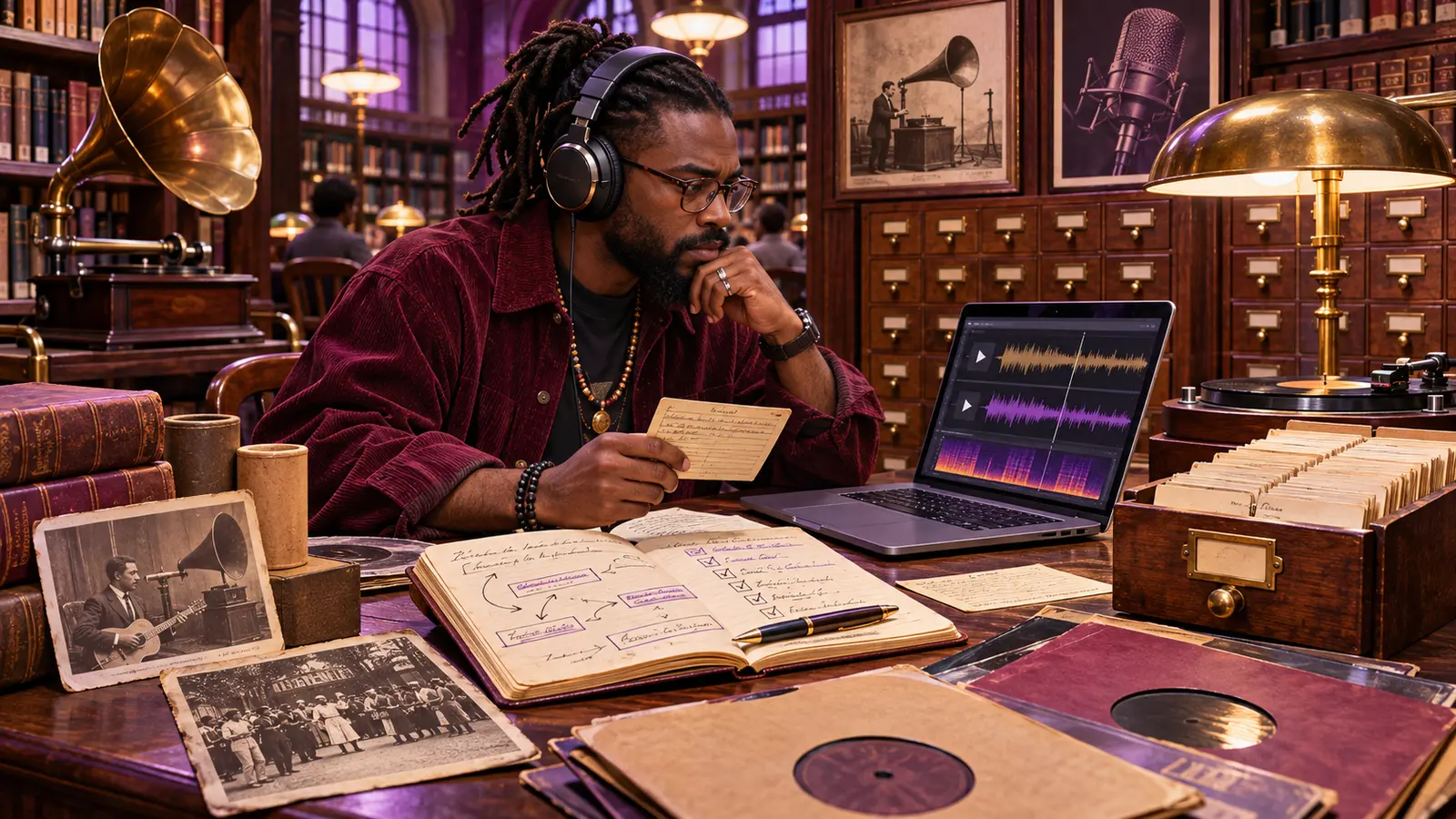
Hip-hop listening can lead backward as well as forward. A rhythm, vocal approach, instrument, label, recording technology, or historical reference may point toward older recorded sound. Public archives can help a listener follow that trail with catalog evidence instead of guessing from an unlabeled clip.
This method is for research and listening, not automatic sample clearance. A catalog entry, public stream, or old recording date does not by itself grant permission to copy, distribute, or commercially reuse audio.
Begin with one audible question
Write a narrow question such as: What earlier recordings use this instrument? How did a vocal style appear in another era? Which label issued this performer? What did dance music from a particular city sound like in a specific decade?
Avoid starting with an unsupported claim that a current artist sampled a particular recording. If no verified credit exists, treat the older music as a listening comparison, not a source accusation.
Search the catalog fields that work
The Library of Congress Recorded Sound Research Center recommends searching by artist, album title, composer, title, date, program, or keyword. Its guidance warns that many holdings are not fully cataloged, so a song-title or subject search may miss relevant material.
Record the exact query, catalog, filters, and access date. If you find nothing, change one field at a time. A failed search is not proof that the recording does not exist.
Read the full record before listening
Capture the title, performer or ensemble, label, matrix or catalog number when present, recording or publication date, format, collection, repository, and stable URL. Keep “unknown” where the record is incomplete. Do not fill gaps with information copied from an unverified upload.
Search a second authoritative record when identity is uncertain. Names, reissues, alternate spellings, and generic titles can point to different recordings.
Use a public stream carefully
The Library of Congress National Jukebox provides public streaming access to historical recordings and browse filters for format, label, date, genre, repository, and other fields. Build a short queue of three recordings rather than collecting dozens of titles you will not hear closely.
For each selection, note one rhythm, texture, performance technique, arrangement feature, or recording artifact. Compare the evidence without flattening different eras and communities into one straight line.
Keep rights information attached
Open the collection's Rights and Access notice and the item record. The National Jukebox states that its streams are available through rightsholder permission, and the Library explains that users remain responsible for deciding whether a proposed reuse is lawful. Streaming access is not the same as reuse permission.
If your project moves from listening into sampling, licensing, publishing, or commercial use, identify the sound-recording and composition questions separately and seek appropriate professional guidance.
Build a traceable discovery trail
Use columns for question, query, catalog, item title, credited performer, date, label, format, stable source, rights note, listening observation, uncertainty, and next lead. Attach citations instead of downloading or reposting material unnecessarily.
Follow one verified label, performer, instrument, city, or collection connection. Continue with IHHR's guide to discovering music through label catalogs when the trail reaches a documented modern catalog.
Bring the context back to current listening
End by replaying a current authorized track and writing only what the historical comparison helped you hear. Do not turn similarity into a genealogy or direct-influence claim without evidence.
Explore more listener-focused research through The Signal. Keep private notes, rights questions, and unverified claims out of public community posts.
References: Library of Congress, Finding Sound Recordings; Library of Congress, National Jukebox—Browse All Recordings; Library of Congress, National Jukebox—Rights and Access. Checked November 7, 2026.
Press Play above to hear IHHR or visit the official Live365 station page.