
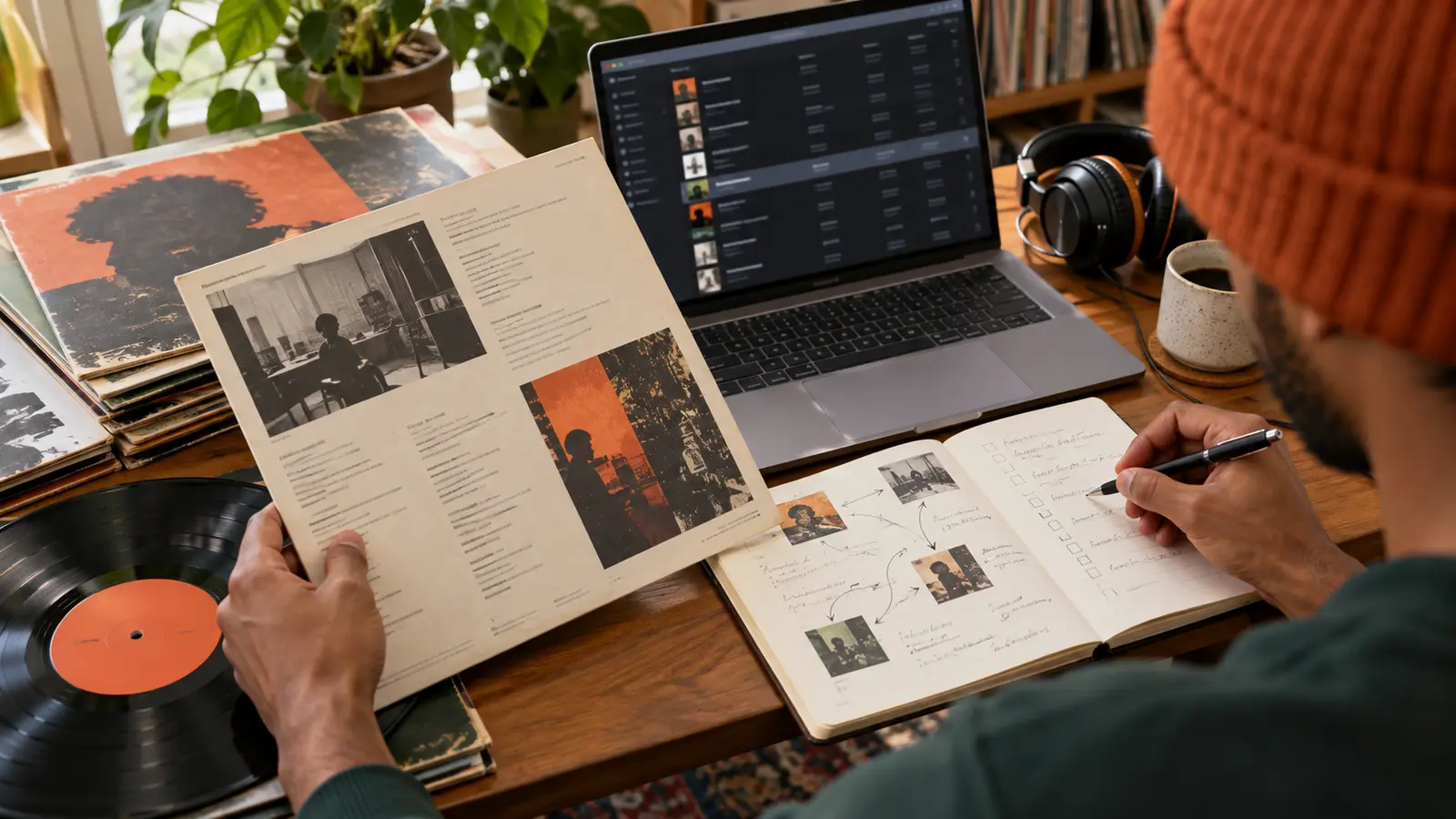
A producer credit can connect songs that recommendation feeds keep apart. Follow one confirmed name and you may find a regional scene, recurring vocalist, independent label, mixing collaborator, or run of releases joined by a recognizable approach.
The method depends on verification. Similar artist names, copied upload descriptions, and incomplete databases can create false connections. Treat every credit as a lead until you confirm it against the release, the artist, the label, or another reliable source.
Start with one recording you already trust
Choose an official release page, physical booklet, label catalog, or artist page that clearly names the producer. Record the song title, primary artist, producer name exactly as credited, release title, date, and source URL or edition.
Do not assume “produced by,” “executive producer,” “additional production,” “beat by,” and “remix by” describe the same contribution. Preserve the wording you found. If the role is unclear, write “credit shown as” rather than translating it into a stronger claim.
Confirm the identity before following the name
Check whether the credited producer has an official artist page, label profile, or consistent identifiers across releases. Compare collaborators, location, name spelling, and linked accounts. A common name can belong to more than one person.
MusicBrainz explains that its database holds artists, releases, recordings, works, labels, and the relationships among them. Its artist relationship guide also recommends placing credits on the most specific known entities—recordings and works rather than only releases or release groups—when the information is known. That structure is useful for research, but community-entered data still needs source checking.
Build a three-step trail
- Same producer, same primary artist: hear how the collaboration changes across two or three tracks.
- Same producer, different artist: compare one release outside the original artist’s catalog.
- New collaborator: choose a featured vocalist, musician, mixer, or label that appears on the second release and follow that verified credit once.
Stop after three steps and listen. The goal is not to collect the largest spreadsheet. It is to reach music you can evaluate with enough context to remember why it connected.
Keep recording, work, and release separate
A recording is a particular audio performance; a work is the underlying composition; a release is a published package or edition. The same work can have different recordings, and the same recording can appear on more than one release. Check which entity actually carries the producer relationship before crediting someone across every version.
MusicBrainz’s relationship editor documentation shows that relationships can be added to a release, its recordings, and related works, with specific types such as producer, vocals, or writer. Use those distinctions as a map, not as permission to fill gaps with guesses.
Listen for continuity without claiming a signature
Compare drum space, low-end movement, sample or instrument treatment, vocal framing, transitions, and section scale. Write observations about the recordings: both hooks clear space before the lead enters, or both arrangements use short percussion responses.
Do not state that the producer created every trait unless a reliable source says so. Many records reflect choices by artists, engineers, musicians, and editors. The stereo-placement listening map offers one way to make focused comparisons without pretending to know the session.
Verify the artist, then support the official path
Once a new artist holds your attention, open the artist’s official release or profile and confirm that the track is part of their catalog. Save or buy through an authorized channel when available. Do not repost files, scrape contact details, or copy private information into a public recommendation.
Use the independent-label catalog method when several discoveries share a label, or the compilation-album guide when a producer appears across a curated multi-artist release.
Turn the trail into a listening queue
Keep one track per discovery step, one sentence about the verified connection, and one question to test on the next listen. Remove entries whose credit cannot be confirmed. A short transparent queue is more useful than a long chain built on copied metadata.
Return to IHHR’s live player for another starting point, browse The Signal, or bring a specific discovery question to the live chat. The IHHR newsletter is the listener-focused route for future stories and station updates.
References: MusicBrainz Database documentation; MusicBrainz Artist Relationship Guide; MusicBrainz Relationship Editor documentation. Checked October 26, 2026.
Press Play above to hear IHHR or visit the official Live365 station page.