
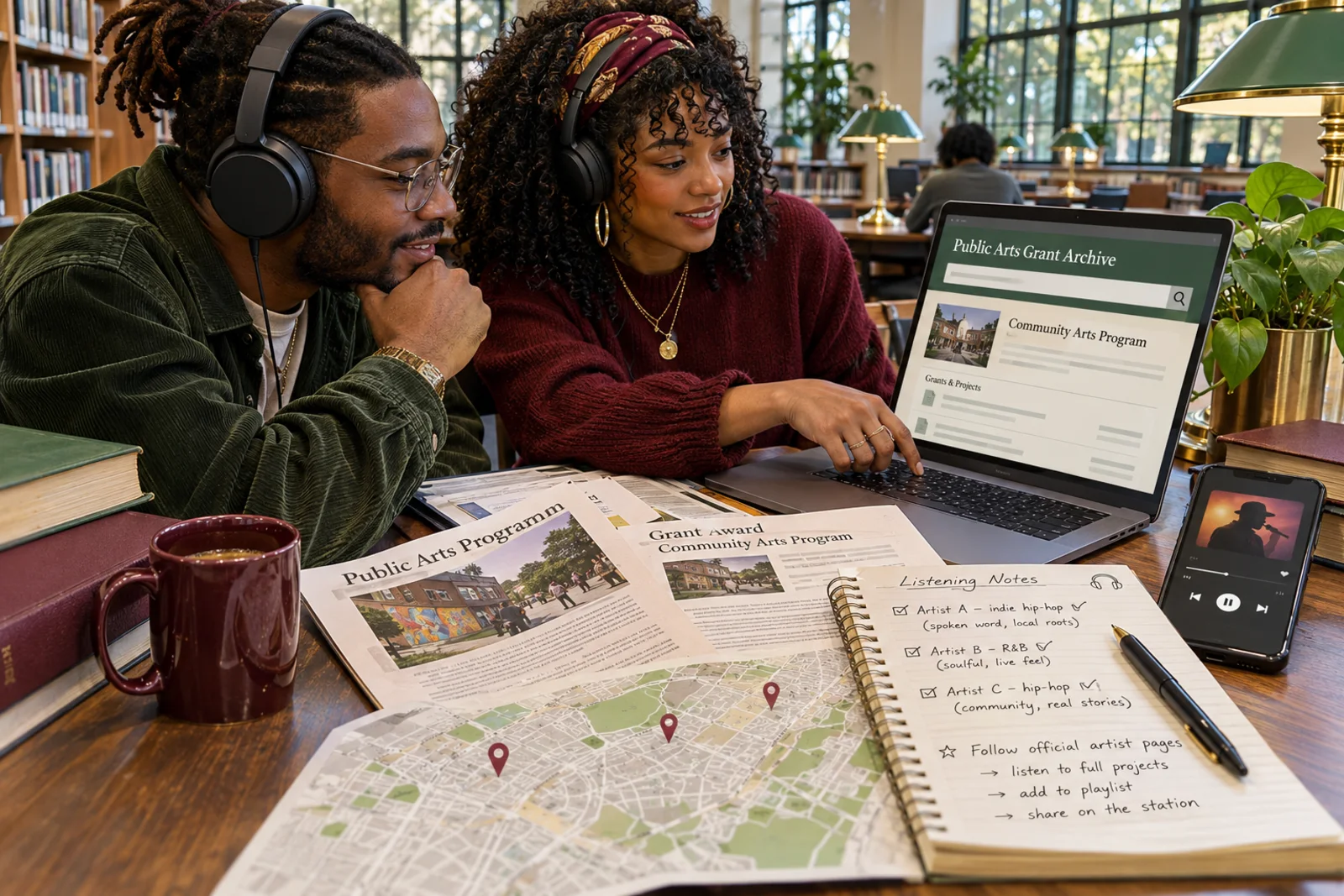
Public arts-grant archives can reveal local presenters, community studios, youth programs, festivals, preservation projects, commissions, and arts organizations that do not always surface in a streaming recommendation. The archive is a starting map—not a playlist, a popularity chart, or proof that every named participant makes hip-hop or R&B.
Use public records to find a project, then verify the people and music through current official sources. Do not turn grant amounts, selection, or institutional language into a claim about artistic quality, audience size, commercial success, or endorsement by IHHR.
Begin with an official public archive
The National Endowment for the Arts points to a Recent Grant Search covering grants to organizations since 1998. State and jurisdictional arts agencies can provide additional local records, and the National Assembly of State Arts Agencies maintains a directory for finding the appropriate agency.
Record the archive name, URL, search date, filter, and result page. Avoid scraped listicles that remove the project description or award year from its source.
Search by project language, not only genre labels
Try terms such as music, recording, radio, oral history, youth arts, performance, songwriting, community studio, archive, festival, residency, or neighborhood. A project may involve rap or R&B without using those exact genre terms, and a genre result may describe an organization rather than an individual performer.
Filter by city, state, year, discipline, or organization when the archive supports it. Save a small number of promising results instead of treating the entire database as a recommendation list.
Read the complete project record
Capture the recipient organization, year, project description, location, amount only when relevant to understanding the project, and official source URL. Notice whether the record describes creation, education, presentation, preservation, research, or facilities. Those categories lead to different kinds of artist discovery.
An organizational grant is not automatically an award to every performer connected with the organization. Do not name an artist until an official program, artist page, event archive, release credit, or comparable source confirms the relationship.
Follow the organization to a dated program
Open the recipient's official site and look for the funded program, season archive, event page, participant list, report, or announcement. Match the grant year and project description. If the current organization page has changed, preserve the uncertainty rather than connecting an unrelated current roster to an older award.
Use the IHHR award-archive discovery method to keep institutional recognition separate from artist verification. The same discipline applies here: the record supplies a lead, and the artist's official work supplies the listening path.
Verify each artist independently
Confirm the displayed artist name, role, project, date, city only when stated, and official listening source. Watch for same-name artists, collectives whose membership changed, producers credited under aliases, and programs that list mentors or speakers rather than performers.
Prefer an artist or label site, official release page, verified program page, or complete credit source. Leave unsupported details blank. Do not copy biographies, program notes, visitor comments, or photographs into a discovery post without permission.
Listen beyond the grant description
Hear one complete official track or performance, then a second item from a different project or year. Note one audible feature—voice, rhythm, instrumentation, arrangement, production texture, or performance approach—without inventing intention or quoting lyrics.
The grant record may describe community impact or project goals; it does not tell you what the music sounds like. Let the recording answer that question.
Build a three-step discovery trail
- Archive: save the official grant result and project context.
- Program: confirm who participated through the recipient's dated source.
- Artist: listen through an official artist, label, release, or program page.
For each trail, keep the three URLs and dates together. If one step cannot be verified, keep the lead private until it can be checked.
Look across years without ranking people
Compare how one city, organization, or project type appears over time. A repeated organization may reveal a durable local program; a new recipient may open a different path. Do not rank artists by grant amount or count awards as audience votes. Funding levels reflect project scope and program decisions, not a universal score for music.
Mix institutional research with direct listening. Use IHHR's permission-based newsletter for station and editorial updates, or return to the live listener and The Signal for additional discovery routes that do not depend on a paid artist service.
Use an eight-question archive check
- Source: is this the official archive or agency record?
- Date: which award year and search date apply?
- Recipient: organization, project, or individual?
- Purpose: creation, presentation, education, preservation, or another activity?
- Participant: what dated source confirms the artist's role?
- Identity: does the official artist source match the same person or group?
- Listening: did you hear complete work through a lawful official route?
- Claim: did you avoid turning funding into a ranking or endorsement?
A grant archive is most useful when it widens your map. Follow the evidence carefully, then let the artists' own releases—not the database—decide where you listen next.
References: National Endowment for the Arts, Recent Grants; National Assembly of State Arts Agencies, State Arts Agency Directory. Checked November 21, 2026.
Press Play above to hear IHHR or visit the official Live365 station page.