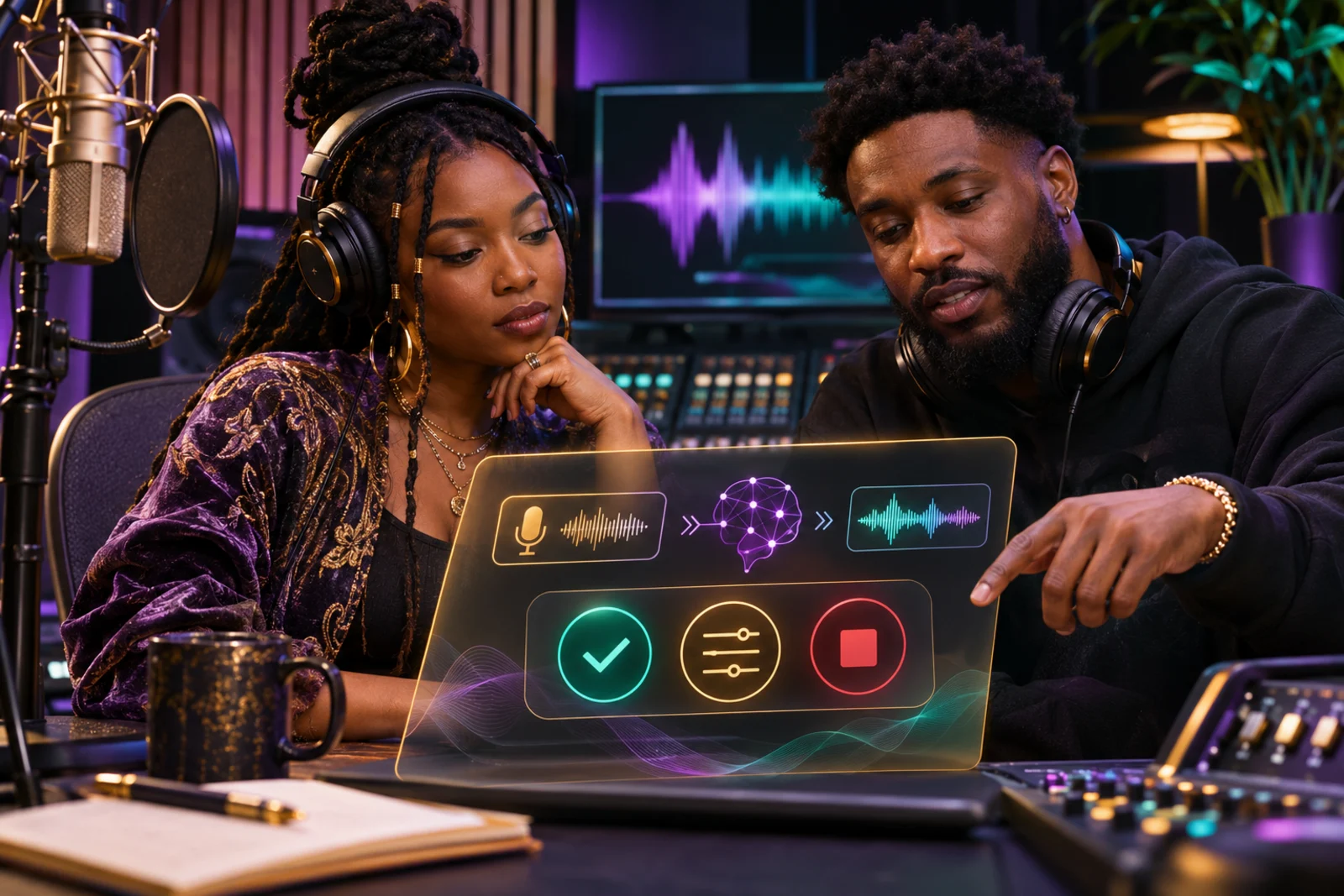
Consent for an AI-assisted vocal session needs more than a casual “yes.” The record should show who agreed, what source audio may be used, which operation is allowed, what output may leave the session, and what remains prohibited. That scope matters whether the tool removes noise, separates stems, changes timing, generates harmonies, transforms a timbre, or creates a synthetic voice.
This workflow is an operational checklist, not legal advice and not proof that every copyright, publicity, contract, union, privacy, or data-protection question is settled. A clear session record helps the team pause before assumptions spread across files, vendors, and releases.
Name the people and their roles
Record the vocalist, producer, engineer, session owner, person operating the tool, and person authorized to approve the output. If a manager, label, publisher, client, or other rightsholder has a separate approval role, list it instead of assuming the performer can answer for everyone.
Identify who is giving permission and what they control. Permission to process a recorded performance does not automatically grant permission to use the composition, copy unrelated sessions, build a reusable voice model, or release a new recording.
Define the source audio precisely
List the exact file name, session or take, recording date, duration, checksum when practical, and where the source came from. Mark whether it contains only the consenting performer or also includes collaborators, guide vocals, spoken conversation, room sound, or material from another project.
Do not upload an entire archive when one approved stem is enough. Duplicate the minimum necessary source into a controlled session folder and keep the original untouched. A narrow input set makes the permission easier to understand and the output easier to audit.
Describe the operation, not just the product name
Write what the system will do: reduce noise, isolate a stem, align timing, suggest a harmony, transform one voice, or generate new phrases. Record the tool and version, account or workspace, date, settings, and whether files are processed locally or sent to a third-party service.
Product labels change, and one tool may perform several very different operations. “Use AI” is too broad to support an informed decision. A performer can approve cleanup while declining training, voice cloning, new lyric generation, or reuse on another song.
Write permissions and prohibitions side by side
Create two columns. Under permitted, name the song, operation, approved users, review audience, release format, territory, time period, and any export allowed. Under not permitted, address model training, model retention, identity imitation, new words, third-party sharing, advertising, sublicensing, future projects, and raw-source publication.
The U.S. Copyright Office's digital-replicas report describes a digital replica as a digitally created or manipulated recording that realistically but falsely depicts an individual, and it discusses consent and compensation as central policy issues. The FTC has separately highlighted fraud, biometric-data misuse, and creative-content misuse among voice-cloning harms. Treat identity-sensitive vocal processing as a high-attention step, not an ordinary plug-in preset.
Set review checkpoints before any public use
Require approval of a short test before processing the full song. Then define separate checkpoints for the edited stem, the mix context, the master, and the exact public asset. Keep “approved for internal review” distinct from “approved for release.”
Use the IHHR AI-generated voice review for an identity, artifact, context, and disclosure pass. Record the file hash or export name approved at each checkpoint so a later render cannot inherit approval automatically.
Plan storage, access, deletion, and withdrawal
List where the source, generated outputs, prompts, settings, and approval record will live. Limit access to named people. Record whether the tool provider retains uploads or outputs and how deletion will be requested where the service offers that control.
Agree on a stop path before the session: who can pause processing, how a concern is reported, which copies must be quarantined, and what happens to unreleased outputs if permission is withdrawn. Withdrawal may have legal or contractual limits after release, so get qualified advice where the stakes require it rather than promising an outcome the team cannot guarantee.
Treat every scope change as a new decision
A new song, tool, model, dataset use, lyric, language, advertiser, territory, distribution channel, or identity effect can change the permission. Add a dated amendment or request fresh approval. Do not rely on a checkbox from a different session.
If the team needs a public, process-focused discussion without uploading files, links, contact details, or private messages, the reviewed IHHR artist forum provides a place to ask a bounded workflow question. Never post another person's voice, consent record, or private concern there.
Use an eight-field consent log
- People: participant, operator, approver, and rights roles.
- Source: exact audio and ownership or control notes.
- Operation: tool, version, setting, and intended transformation.
- Permission: song, users, outputs, audience, and duration.
- Prohibitions: training, reuse, cloning, sharing, and new words.
- Review: test, stem, mix, master, and release checkpoints.
- Data: storage, access, retention, deletion, and vendor terms.
- Stop path: pause, escalate, quarantine, and document changes.
Attach the log to the session and preserve dated approvals with the corresponding exports. When any field is uncertain, stop before upload or release. A blank field is a question to resolve, not permission to improvise.
References: U.S. Copyright Office, Copyright and Artificial Intelligence, Part 1: Digital Replicas; Federal Trade Commission, Voice Cloning Challenge; FTC, Approaches to Address AI-enabled Voice Cloning. Checked November 15, 2026.
Press Play above to hear IHHR or visit the official Live365 station page.