
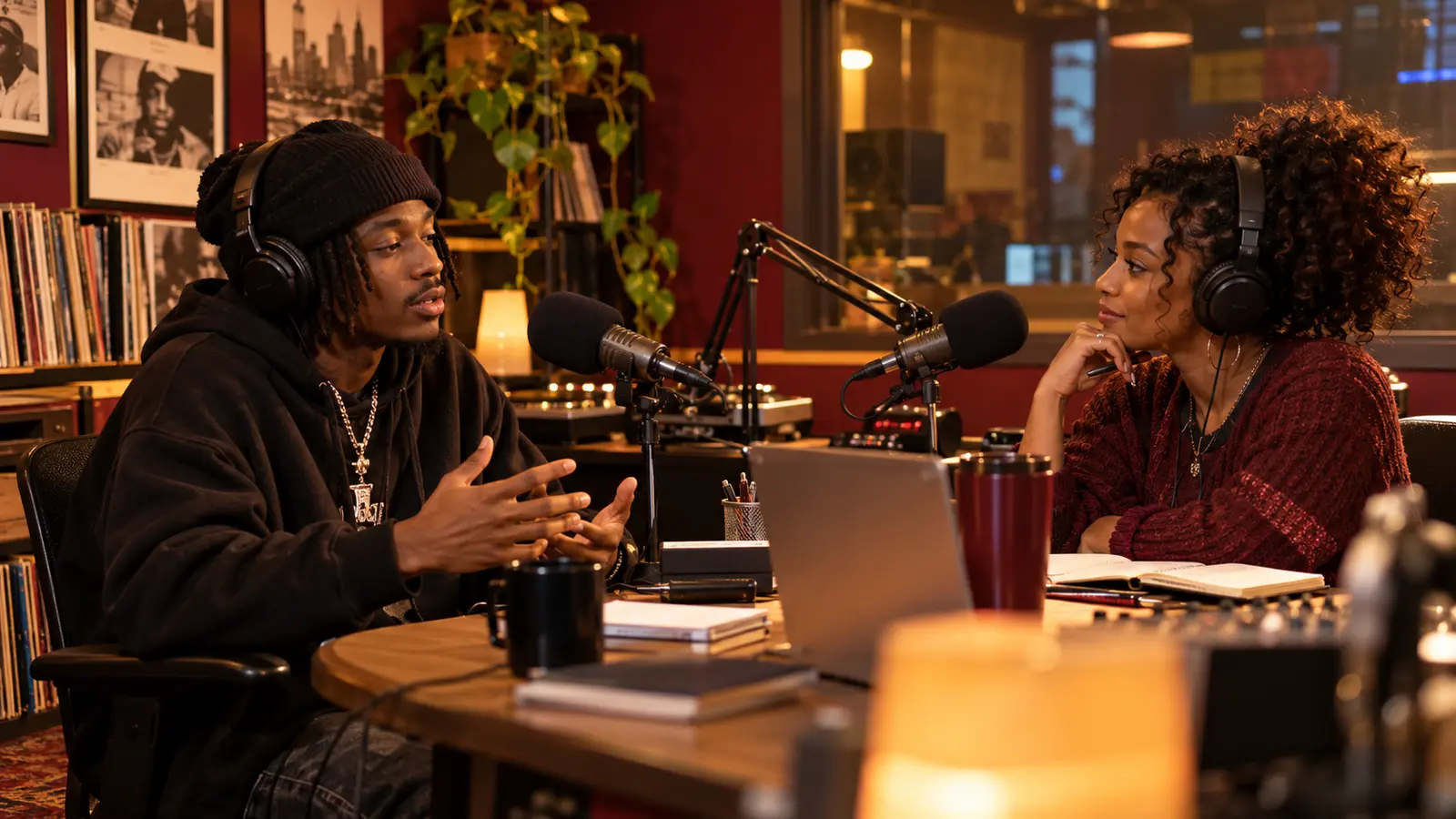
A good artist interview gives listeners a way into the music. It does not require a polished slogan for every question. It requires a few accurate facts, stories that reveal creative decisions, and enough preparation to answer the question in front of you instead of delivering an advertisement.
Use this routine for a podcast, community-radio conversation, written Q&A, or release feature. Adapt the length and tone to the actual format rather than treating every appearance as the same opportunity.
Confirm the format before rehearsing
Ask whether the conversation is live, recorded, edited, written, or on camera; how long it will run; who the audience is; and whether music or a performance is planned. Confirm the date, time zone, location or call link, technical setup, and the person to contact if something fails.
Do not assume you can approve an independent interview before publication. Ask about factual corrections and editing policy in advance. A sponsored feature may have a different review process: IHHR's paid Artist Spotlight includes an artist-reviewed sponsored feature and written Q&A, not an independent endorsement.
Build a one-page fact sheet
Write the approved artist name and pronunciation, release title, release date, contributor names and roles, official listening link, and a short description of the project. Separate a planned release from one already available. If a credit, location, award, placement, or number cannot be verified, leave it out.
Keep this sheet beside you during a remote conversation. It is a reference, not a script. Use the existing independent-music one-sheet guide to organize the essentials without turning the page into a full biography.
Prepare three stories, not thirty talking points
Choose one story about a decision, one about a problem, and one about a change. A decision might explain why the hook became quieter. A problem could describe finding a delivery that stayed clear over dense drums. A change might show how a collaborator reshaped the ending.
Give each story a beginning, a concrete moment, and an audible result. “We took the bass out of the first hook, then brought it back in the last one so the ending felt earned” tells the listener what to notice. “We worked very hard” does not.
Use an answer with three parts
- Answer: respond directly in one sentence.
- Example: give one specific moment or choice.
- Meaning: explain what it changed for the song or listener.
Practice the same answer in thirty seconds and ninety seconds. The shorter version helps in a live segment; the longer one gives a host room to follow up. Stop after the meaning and let the interviewer respond. A pause is not an emergency.
Know what you will not share
Decide which family details, private relationships, unreleased material, collaborator disputes, and business terms are outside the conversation. Prepare a calm boundary: “I keep that part private, but I can explain how the experience shaped the song.” Do not assume a microphone is off or that “off the record” applies without an explicit agreement.
Do not invent hardship to make a release seem important. You can discuss craft, curiosity, humor, ambition, or ordinary life without manufacturing a dramatic origin story.
Rehearse the actual setup
Record a short practice conversation on the device you will use. Check microphone distance, room noise, headphones, camera framing when relevant, and whether your connection is stable. Keep water and the fact sheet nearby. Listen for rushed openings, repeated filler, unclear names, and answers that never reach a point.
If the appearance includes a performance, agree on the exact backing file rather than sending a commercial master and hoping it works. The companion instrumental and performance-track version guide helps distinguish those files.
Make the music easy to discuss
Pick one listening cue a new audience can hear immediately: the way a verse shifts rhythm, a harmony that enters late, or the conversation between kick and bass. Our rap and R&B bassline listening guide offers vocabulary for describing the low end without guessing equipment or production methods.
After the interview, send any promised facts promptly and request corrections for specific errors without demanding a different opinion. Share the published conversation with accurate context, credit the host, and disclose sponsorship when applicable. Continue exploring artist craft in The Signal or return to IHHR's live listening page.
Press Play above to hear IHHR or visit the official Live365 station page.