
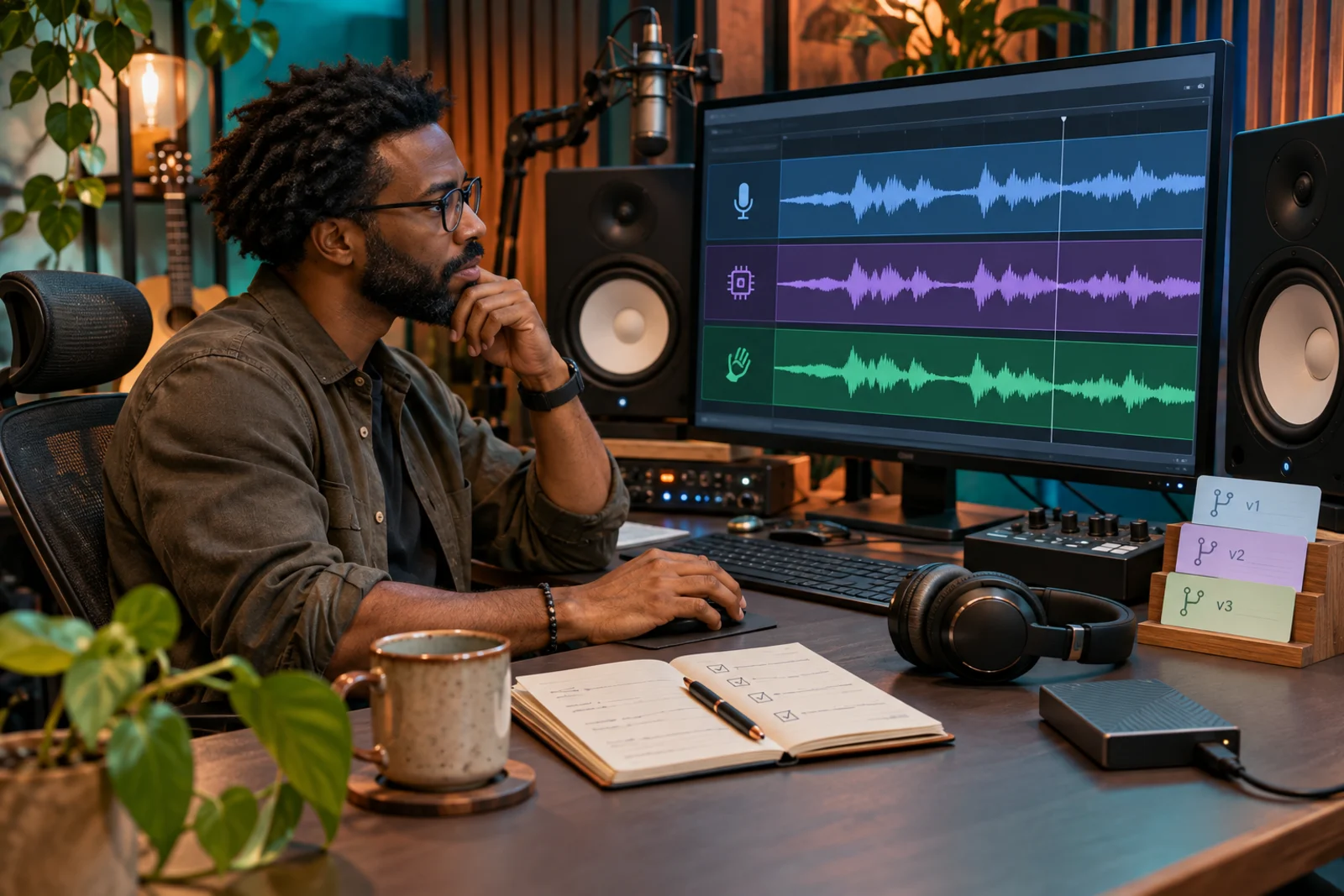
An AI-assisted edit should not become permanent merely because it sounded promising in one session. Denoising, source separation, timing repair, restoration, pitch work, generative fill, or another assisted process can alter details beyond the intended target. A reversible workflow lets the team return to the authorized source, reproduce the test when possible, and choose a non-AI path without rebuilding the project from memory.
Reversible does not mean risk-free. It does not establish copyright, consent, safety, or product reliability. It means the project has preserved enough source, context, and decision history to stop, compare, replace, or recover.
Freeze the authorized source
Duplicate the source into a read-only or otherwise protected location before processing. Record its exact filename, format, sample rate, bit depth, channel layout, duration, source owner, permission, and a checksum when your workflow supports one. Never overwrite the only copy.
Use the IHHR music-project backup routine to keep the source and project package in more than one controlled location. A duplicate inside the same failing drive or synced mistake is not a complete recovery plan.
Define the target and the stop conditions
Write one observable goal: reduce a named noise during a defined range while preserving intelligibility, timing, ambience, and the artist's approved performance. Then list what will stop the test: identity change, smeared transients, shifted duration, new leakage, changed words, lost ambience, unstable repeats, privacy concern, or any result outside contributor permission.
Keep the affected time range as narrow as practical. Processing a full track to repair one moment increases the surface area for unnoticed change.
Capture the processing conditions
Record the provider, product, feature, visible model or version, account or workspace, operator, date, input ID, settings, prompt or instruction where relevant, and output ID. If the provider does not expose a model or deterministic seed, write “not shown” rather than guessing.
Save screenshots or exports only when permitted and useful, and keep them beside a searchable text record. Do not place sensitive vocals, tokens, passwords, or private contributor information in a screenshot shared beyond the authorized team.
Create three lanes, not one replacement
Keep an untouched source lane, an AI-assisted candidate lane, and a fallback lane. The fallback might use manual editing, approved conventional processing, a new performance, or the untouched source. Align the lanes to the same timeline and route them through the same comparison path.
Do not hide the candidate under the source filename. Use clear version labels and keep the processed range visible. If the candidate enters a larger mix, preserve the earlier session and print a reference so the team can return to the comparison state.
Compare blind spots as well as the target
Listen before, inside, and after the processed range. Check the candidate alone, against the untouched source, and in context. Level-match when appropriate so louder does not masquerade as better. Inspect timing, phase, stereo image, breath, consonants, transients, tails, background vocals, room tone, and the transition into unprocessed audio.
Use the IHHR AI-assisted version-drift audit if the edit changes duration, section placement, or downstream stem alignment. A small local improvement can still break a clean edit, performance track, video cut, or collaborator session.
Assign an accountable human decision
Name the operator, reviewer, affected contributor when relevant, and final approver. The reviewer should be able to hear the source and candidate without relying only on the person who made the edit. Record accept, revise, replace with fallback, or reject, plus the intended use.
NIST's AI Risk Management Framework includes human oversight, viable non-AI alternatives, recovery, change management, and mechanisms to disengage or deactivate systems whose outcomes do not match intended use. Those principles are broader than a studio edit, but they support a practical rule: preserve an exit before the candidate becomes a dependency.
Prove the fallback actually opens
Close the session, reopen the protected source and fallback from their recorded locations, and confirm that the files play, align, and contain the expected material. Test a restore on a separate copy when the project is important. A written fallback that depends on a missing plug-in, expired link, or overwritten session is not usable.
Keep the rejected candidate only as long as the project, consent, privacy, and retention rules allow. Reversibility is not a reason to retain sensitive material indefinitely.
Promote the candidate deliberately
If approved, copy the candidate into the delivery path under a new stable version, update the mix or release record, and name the decision that authorized it. Do not let an autosave, sync client, or relink operation replace the original source across older sessions.
If rejected, remove the candidate from delivery and automatic relink paths, preserve the decision record, and continue from the fallback. A new tool, model, input, or setting is a new test—not an automatic correction of the earlier one.
Use a ten-part reversibility check
- Source: authorized original protected and identified.
- Goal: bounded repair or transformation written.
- Stops: unacceptable changes named in advance.
- Conditions: tool, version, settings, operator, and date captured.
- Lanes: source, candidate, and fallback kept separate.
- Comparison: processed range and surrounding context reviewed.
- Dependencies: downstream timing and versions checked.
- Decision: accountable human approves, revises, replaces, or rejects.
- Restore: source and fallback reopened successfully.
- Promotion: only the approved version enters delivery.
A reversible edit gives experimentation an honest boundary. The team can use an assisted result when it earns approval—and leave it behind when the music, rights, or evidence say no.
References: NIST AI RMF Core; NIST AI RMF Playbook, Manage. Checked November 22, 2026.
Press Play above to hear IHHR or visit the official Live365 station page.