
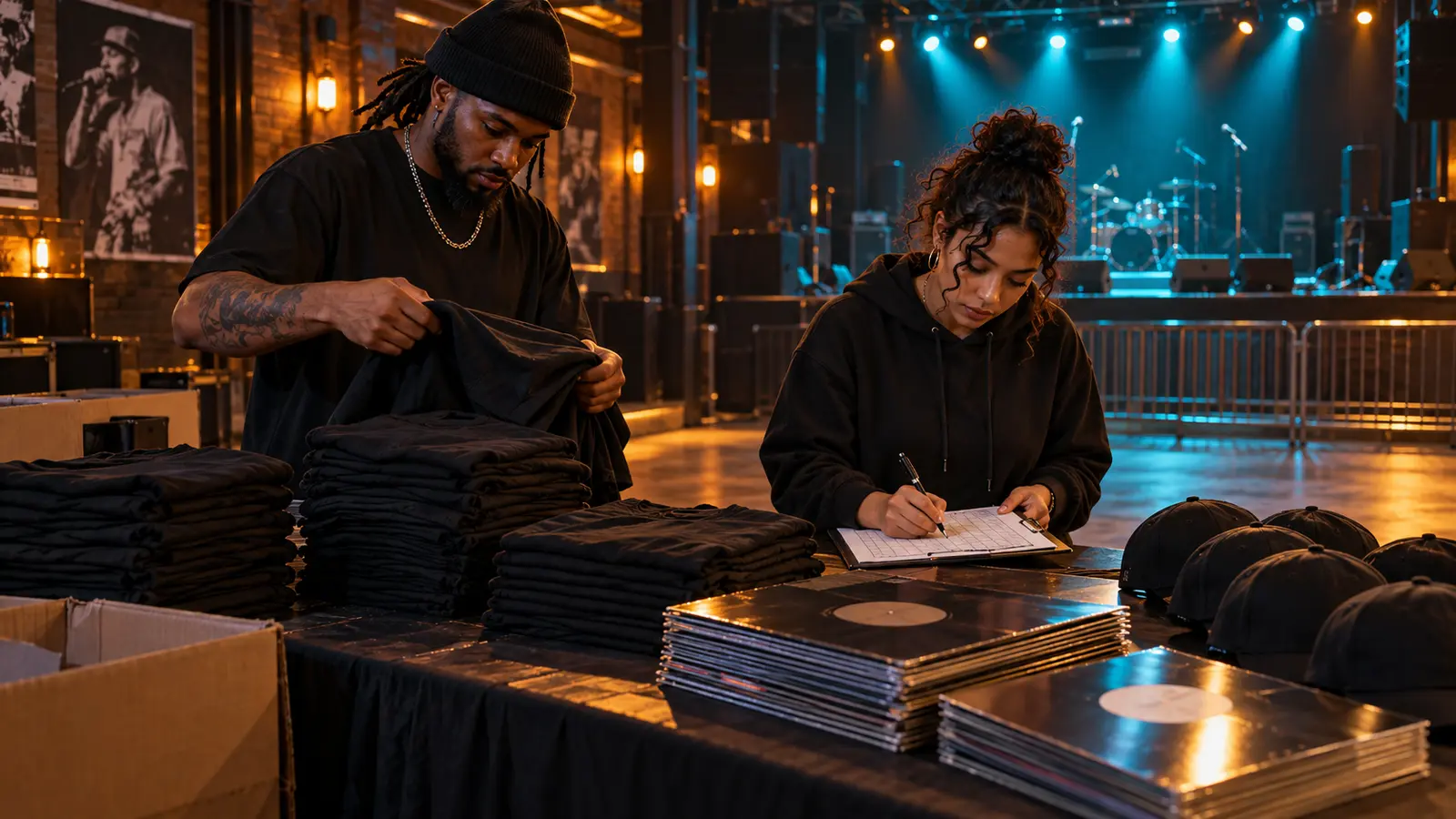
A merch count sheet should answer one plain question after the venue clears: what arrived, what left for a documented reason, and what should still be in the boxes? A memory-based count cannot separate sales from artist comps, damaged goods, misplaced sizes, or an arithmetic mistake.
This workflow is for a small independent show. It does not replace tax, accounting, venue, or payment-platform advice. Keep the original payment reports and receipts, and use the same item names in every record.
Give every variation its own row
List the item, design, size or edition, sale price, and storage location. A small black shirt and a medium black shirt need separate rows because they are different stock. Give vinyl color variants, signed editions, bundles, and hats distinct rows too.
Use short names that a second person can understand under pressure. Match those names to the point-of-sale catalog if you use one. If the artist is also running soundcheck, hand the sheet to one named merch lead rather than letting several people change it independently.
Count before the table opens
Record an opening quantity for every row while the boxes are still controlled. Count the sales-table stock and reserve stock separately, then add them for the opening total. Have the counter initial the sheet and note the time.
Square currently distinguishes a full count, which physically verifies the entire stock, from a cycle count, which checks a subset. Its support guidance warns that approving a full count can set uncounted variations to zero. Even if you use another system, the lesson is useful: define whether the show count covers every variation or only the merchandise traveling that night.
Create a reason for every non-sale exit
Add columns for paid sales, artist or crew comps, promoter or press comps, damage, returns, and transfers back to another location. Never bury a free shirt inside the sales column. Write the recipient category and have the merch lead approve the movement; do not put private contact information on a shared sheet.
If a bundle contains a shirt and record, decide before doors whether it will reduce both component rows or its own prepacked bundle row. Use one rule for the whole night. Square’s current inventory tools likewise let operators apply adjustment reasons, which is a useful model for separating a sale from another stock change.
Keep payment totals separate from unit counts
Track cash, card, and other approved payment methods in their own summary. The unit sheet proves how many pieces moved; the payment report proves how money was collected. They should support each other, but they are not interchangeable.
Record the starting cash bank, cash added, refunds, approved expenses paid from the drawer, and ending cash. Do not edit the card processor total to make it fit the inventory. Investigate the difference instead.
Reconcile with one equation
For each row, calculate expected closing stock as opening quantity minus paid units, comps, damage, and transfers out, plus returns or transfers in. Then physically count the closing stock. The difference between expected and actual is the variance.
Circle every nonzero variance and resolve it while the table, boxes, payment reports, and crew are still available. Check look-alike sizes, items placed in the wrong box, unrecorded bundles, and duplicate taps before assuming theft or changing records.
Close the night without destroying the audit trail
Photograph or scan the completed sheet, export the payment summary, label the remaining boxes, and save everything in one dated show folder. Enter approved adjustments into the main inventory only after the sheet has been reviewed. Preserve the original rather than rewriting it into a cleaner story.
Pair the count with the independent rap show tech-advance checklist and the timed setlist workflow so the same show folder covers performance and sales operations. If the numbers expose a broader promotion-budget decision, use IHHR’s goals-and-budget campaign finder to compare sponsored service scope without treating merch revenue as guaranteed marketing return.
Use the next show to improve the sheet
After the count is approved, note which variations sold, which were repeatedly requested but unavailable, and which rows caused confusion. Do not promise future demand from one event. Use the evidence to improve labeling, packing quantities, pricing display, and staffing for the next table.
Artists can discuss practical show workflows in the reviewed artist forum. Keep private sales data out of public posts, and continue through The Signal for more independent-artist operations guides.
References: Square Support, Conduct, review, and approve inventory counts; Square Support, Adjust inventory levels. Checked October 28, 2026.
Press Play above to hear IHHR or visit the official Live365 station page.