
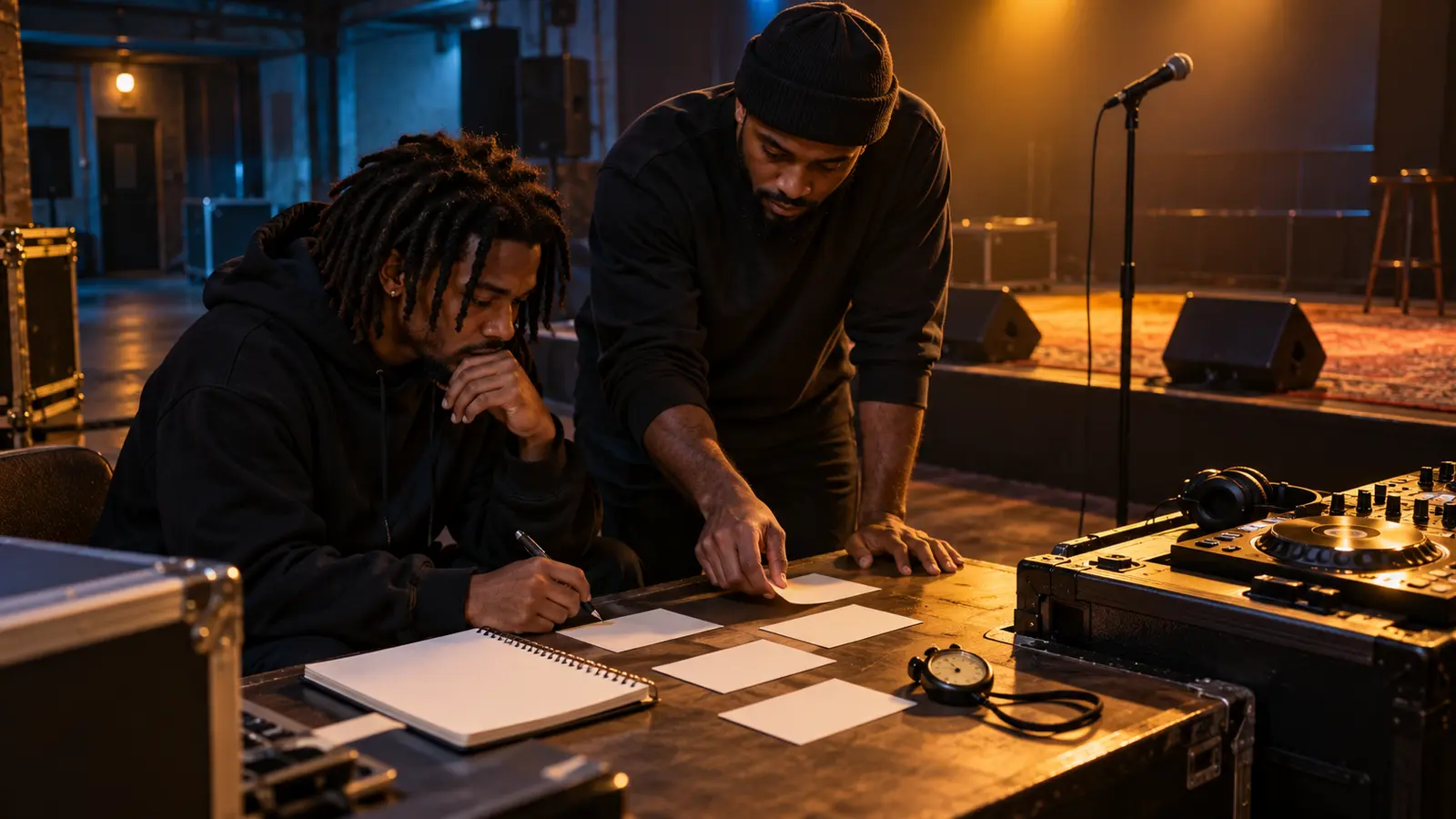
A fifteen-minute slot is not fifteen minutes of songs plus introductions, applause, and a final speech. A useful setlist is a plan for the whole performance, including the moments when no track is playing. Measuring those moments in rehearsal gives the artist and DJ choices before the room puts them under pressure.
This is a planning method, not a universal venue rule. Confirm the actual slot and production requirements with the organizer rather than assuming every showcase runs the same way.
Confirm when the clock starts and stops
Ask whether the allocation includes walking on, introductions, equipment changes, and clearing the stage. Confirm who gives the start and finish cues, whether there is a visible clock, and what happens if the program is running late.
Also check the audience and content expectations, available playback setup, microphone arrangements, and delivery deadline. Do not discover at soundcheck that the venue expected a different file or that a guest needs a microphone nobody requested.
Measure the versions you will perform
Use the exact performance files, not the running times of the commercial releases. A shortened intro, extra hook, clean replacement, or live ending changes the timing. Label each version so the DJ and performer are rehearsing the same arrangement.
The instrumental and performance-track guide explains how to keep those files distinct. Do not replace a tested backing file with a last-minute export without another full rehearsal.
Give each selection a job
Choose an opener that makes the artist's presence clear, a middle that introduces contrast, and a closer that finishes deliberately. Those jobs do not require three different songs; a very short set may need fewer selections with stronger transitions.
A setlist is not automatically the EP's track order or a sequence from least to most popular. Ask what each song adds in this room. If two selections do the same work and time is tight, keeping both may weaken the set rather than demonstrate range.
Budget the spaces between songs
Write down greetings, title announcements, guest introductions, audience responses, and the closing thank-you. Rehearse concise versions without assuming the crowd will behave on cue.
For an illustrative fifteen-minute allocation, nine minutes of music, two minutes of planned speech, one minute of transitions, and three minutes of reserve total fifteen. These are example planning numbers, not a recommended ratio for every show. Replace them with measurements from your own run-through.
Write cues another person can follow
- Start: the agreed signal and who gives it.
- Entry: the vocal landmark or count-in the performer uses.
- Transition: a stop, overlap, spoken moment, or immediate next track.
- End: the exact musical finish and when speech begins.
- Fallback: what to omit if the available time shrinks.
Keep the cue sheet readable under ordinary stage conditions. Avoid ambiguous instructions such as “cut it when it feels right.” Use the song-ending listening guide to distinguish a fade, a final hit, and an outro that still has musical information in it.
Rehearse the complete clock
Start the timer before the first entrance and stop after the last planned action. Include the actual speech and transitions. Run the set without restarting after every mistake so you learn where timing drifts.
Review the recording for rushed words, uncertain cues, repeated introductions, and gaps that are accidental rather than expressive. Use the clear-delivery rehearsal routine for a difficult passage instead of solving every timing problem by performing faster.
Prepare a shorter route before show day
Agree on a version that removes a whole selection or optional spoken section while preserving a clear ending. Do not make the DJ guess which verse you have silently decided to skip. Keep both cue sheets and files unmistakably labeled.
If an AI-assisted draft is still competing for a place, use the variation-selection method to decide what is actually ready rather than generating new options on the way to rehearsal. Ask general workflow questions in the reviewed artist forum without posting private files or contact details.
More performance and release guidance is in The Signal. Return to IHHR's live stream and notice how different recordings establish an opening and a finish.
Press Play above to hear IHHR or visit the official Live365 station page.