
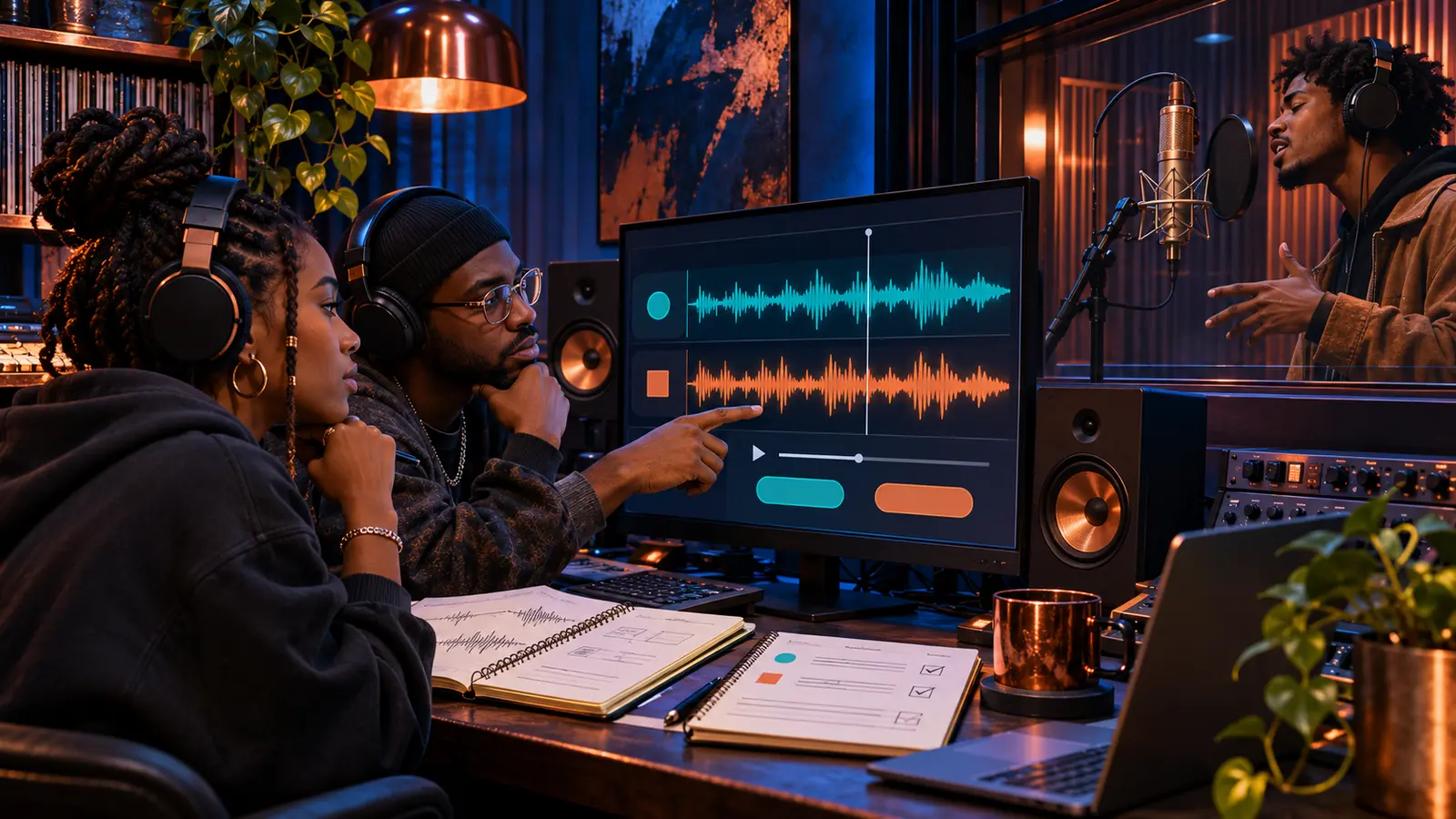
An AI-assisted demo can communicate structure, pacing, or a production direction without becoming the release master. A human re-recording creates a new performance and may change phrasing, tone, arrangement, and emotional emphasis. Comparing the two responsibly means preserving what each version contains and judging the audible result against an agreed brief.
This workflow is not a copyright ruling or clearance process. Tool terms, source permissions, voice and likeness rights, contracts, and platform policies can differ. Never imitate an identifiable person's voice without authorization, and never describe a generated performance as human-recorded.
Freeze the demo and document its source
Save the exact demo file, creation date, tool and feature, account or license context, authorized inputs, prompt or direction record, and known limitations. Give it a checksum or other stable internal identifier. Do not regenerate the source midway through the comparison.
Use the IHHR AI music session log to separate inputs, generated outputs, human edits, and approvals. The U.S. Copyright Office's 2025 report says AI used as an assistive tool does not bar copyright protection for a larger human-authored work, while protection depends on sufficient human-authored expressive elements rather than prompting alone.
Write what the re-recording is meant to preserve
List the demo features the team actually values: section order, tempo feel, chord movement, rhythmic pocket, melodic contour, lyric concept, instrumental texture, or approximate duration. Verify what the team has permission to reuse. Do not treat the entire generated output as a blank check.
Then identify what the human session should reinterpret: breath, articulation, register, ad-libs, dynamics, timing, live instrumentation, or structure. A human re-recording should not be judged only by how closely it copies a synthetic reference.
Prepare a clean human session
Build a recording session with labeled guide, instrumental, tempo map if verified, lyric version, section markers, and a take log. Tell the performer which elements are fixed and where interpretation is welcome. Obtain consent for recording and for any later model training or voice processing as separate decisions.
If the instrumental itself is AI-assisted, use the human-vocal session preparation guide to preserve the source and create a stable working bounce. A performer cannot approve a moving target.
Record complete takes before assembling a comp
Capture several full or section-length takes so the performer can establish continuity. Then record deliberate alternatives for entrances, endings, difficult transitions, and ad-libs. Keep every take under a stable identifier and record the reason for pickups.
Do not claim that a comp is one uninterrupted performance. A finished human master may combine authorized takes and edits while remaining a human performance; the session record should say what actually happened.
Match the review conditions
Export the demo and re-recording at matched loudness for review, using the same start point and comparable file quality. Loudness can make one option seem more exciting even when the arrangement or performance is not stronger. Keep an unmatched archive copy of each source.
Label the files neutrally, such as Version A and Version B, for a first pass if the reviewers already understand what is being tested. Do not use blind labels to hide a material consent or provenance issue.
Score musical questions, not identities
Review section by section for lyric clarity, rhythmic fit, melodic shape, emotional progression, dynamic contrast, transitions, tone, background-vocal space, and compatibility with the arrangement. Add a field for “keep,” “revise,” or “not comparable.” A synthetic demo may include artifacts a human voice should not be asked to reproduce.
Collect independent notes before discussion, then compare them. Avoid statements such as “human is always better” or “AI is cleaner.” Name the specific audible choice and its effect in this song.
Make hybrid decisions visible
The best next step may preserve the demo's section map while using the human lead, rewrite one melody, replace generated backgrounds, or rebuild the instrumental. Record each retained element and its source. Hybrid does not mean provenance can be blurred.
For the final approval pass, use the human-approval checklist for an AI-assisted mix. Confirm the exact master, disclosures, credits, permissions, metadata, and people authorized to approve it.
Archive the comparison without overstating rights
Store the frozen demo, raw human takes, comp notes, edits, review exports, decision log, approvals, tool terms captured at the relevant time, and final delivery file. Record factual contributions: performed by, edited by, produced by, AI-assisted element, and human arrangement or modification. Do not use a credit line to imply a legal conclusion nobody has made.
Discuss general workflow questions in the reviewed artist forum without uploading private stems, cloned voices, prompts containing confidential material, or disputed files. Continue through The Signal for responsible AI and independent-music guides.
References: U.S. Copyright Office, Copyright and Artificial Intelligence Part 2 release; U.S. Copyright Office, Copyright and Artificial Intelligence Part 2 report. Checked November 2, 2026.
Press Play above to hear IHHR or visit the official Live365 station page.