
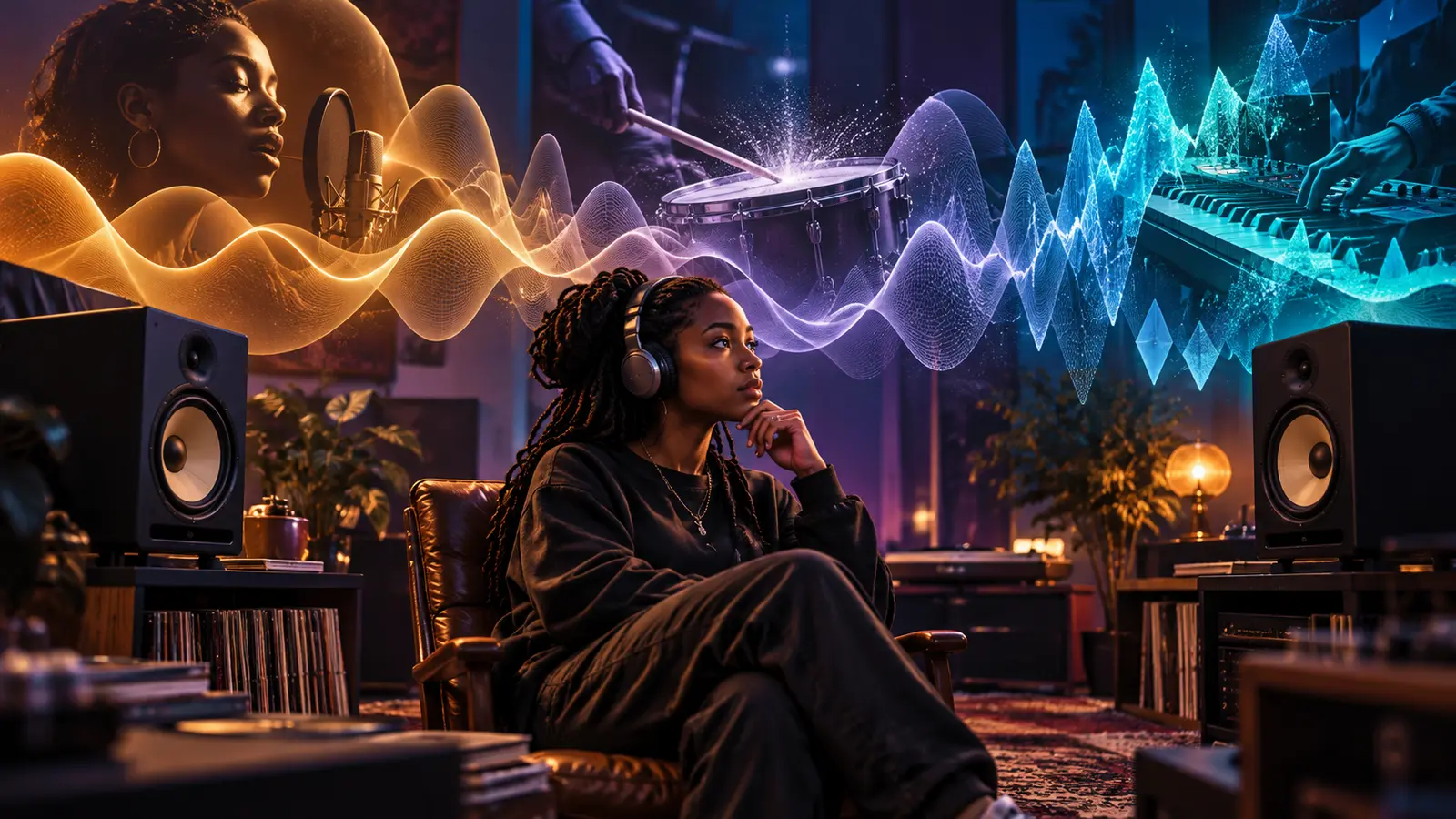
Timbre is the character or tone color that helps two sounds feel different even when pitch or level is similar. A voice can move from rounded to edged, a snare from soft to crisp, or a synth from smooth to grainy while the song remains recognizably itself.
This exercise describes the released recording. It cannot identify a microphone, instrument, plug-in, sample pack, vocal chain, or AI tool unless the artist or credits document it. Write what changes, when it changes, and what musical job the contrast performs.
Choose one short section and one sound
Use the official full-length recording at a fixed, comfortable level. Pick a verse-to-hook transition or a verse-to-bridge change. On the first pass, follow only the lead voice, snare, bass, or one musical layer. Trying to label every sound at once usually turns observation into vague praise.
OpenStax describes timbre, or tone quality, as our perception of combinations of frequencies and intensities. That definition gives you a starting point, not a requirement to run technical measurements before listening.
Build a pair of contrast words
Write two neutral descriptors that help you compare the same element across moments: soft-edged or sharp-edged, smooth or grainy, dark or bright, clean or rough, thin or full, breathy or firm. These are listening notes, not objective diagnoses.
Avoid turning a descriptor into a value judgment. A rougher vocal is not automatically worse, and a brighter snare is not automatically clearer. Ask whether the change separates a section, answers a lyric, raises tension, or shifts attention.
Use A-B-A listening
Play the earlier moment, the changed moment, then the earlier one again. Keep the volume fixed. Write the timestamp and one sentence: “The hook vocal has a firmer edge than the verse vocal, then the verse returns to a softer tone.” Repeating the first moment checks whether memory exaggerated the difference.
Pair this with the dynamic-contrast listening exercise so a louder event is not automatically mislabeled as a timbre change. Then use the front-to-back depth map to separate tone color from apparent distance.
Follow the voice without inventing a cause
Compare consonant edges, breath, vowel weight, rasp, air, and the transition between chest voice, head voice, singing, and rap delivery. Notice whether doubles or harmonies change the combined color when they enter. Do not claim a particular mic, saturation setting, or vocal model from the sound alone.
Mark the exact line entrance or section rather than quoting lyrics. If the tone changes only on a response or ad-lib, compare that role with the lead instead of treating the whole vocal as one continuous color.
Trace drums, bass, and instruments separately
On new passes, follow the snare or clap, then the bass, then one sample, key, guitar, or synth. Listen for how attack, sustain, noise, resonance, and upper detail change. A drum may keep the same rhythm while its character shifts at the hook; a bass may retain its notes while becoming more textured.
Ableton’s current reference describes Spectrum as a measurement tool that displays amplitude against frequency and does not alter the signal. The same manual calls EQ Eight useful for changing timbre. Those facts can explain why a spectrum or equalizer exists, but a visible graph still cannot prove how an unknown released track was made.
Map the arrangement’s color arc
Create one row for intro, verse, hook, bridge, and outro. Give each row no more than three observations. Look for a pattern: perhaps the verse keeps muted colors, the hook adds brighter percussion and firmer support voices, and the outro removes those edges.
Then listen once without stopping. Ask whether the color arc supports the song’s emotional movement. If the notes become too technical to explain the experience, return to one timestamp and one audible comparison.
Share an observation, not a studio myth
A useful note names the element, time, contrast, and role: “At 1:02, the snare becomes sharper at the hook and helps separate it from the softer verse.” An unsupported note says, “They definitely switched to this exact processor.” Keep the first and leave the second unknown.
Try the exercise with the live IHHR player, find more close-listening guides in The Signal, or join the IHHR newsletter for station updates. Do not post copyrighted lyrics or claim private session knowledge in the community.
References: OpenStax, College Physics 2e, Hearing; Ableton Live 12 Manual, Live Audio Effect Reference. Checked October 28, 2026.
Press Play above to hear IHHR or visit the official Live365 station page.