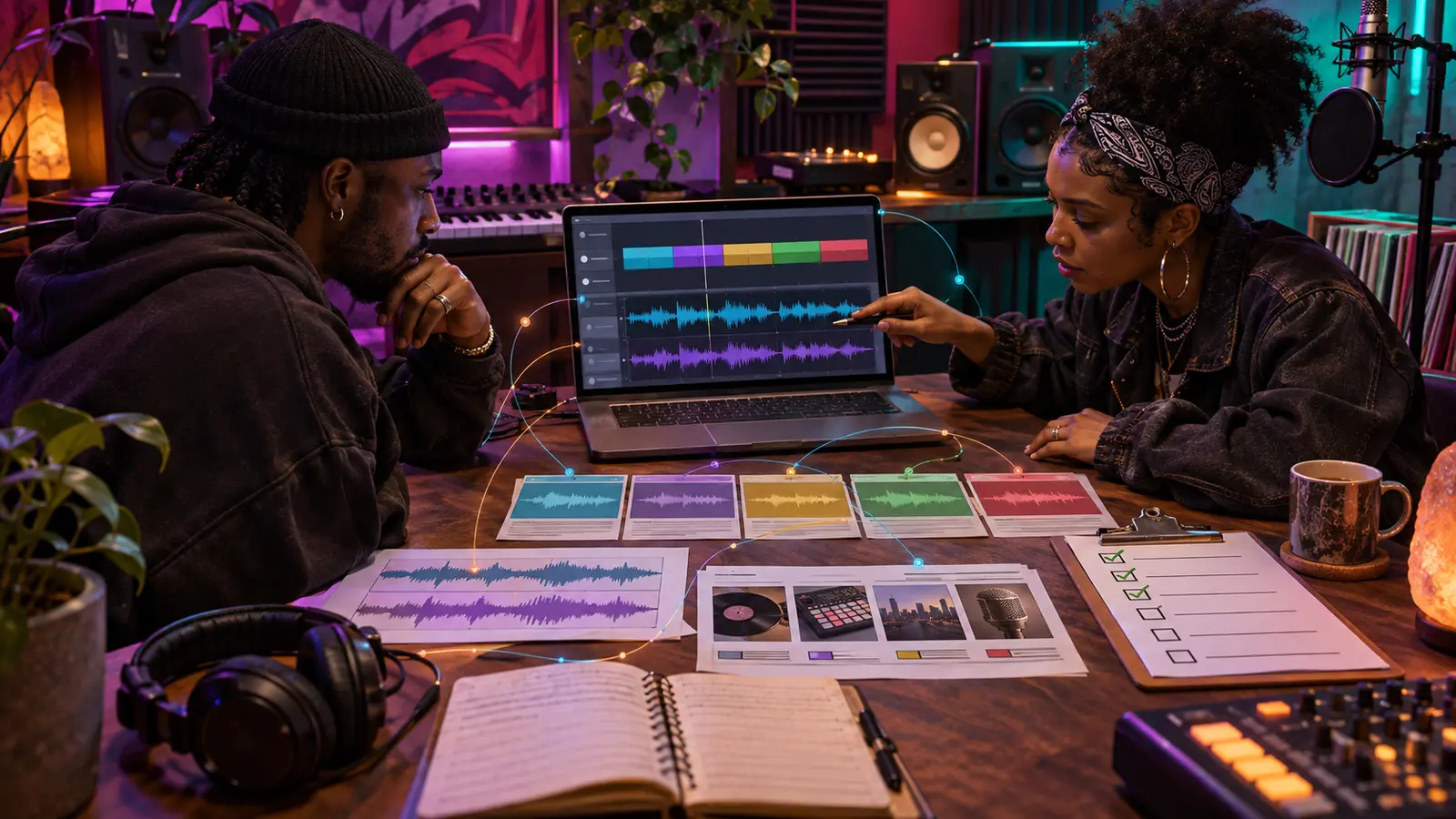
An AI-assisted arrangement can sound finished while important decisions remain undocumented. A human decision pass slows the project down long enough to identify every section, confirm where the material came from, test the full sequence, and record who approved the final structure.
This checklist does not decide copyright ownership or replace legal review. Platform terms, contracts, source permissions, performer consent, and the facts of the project still matter. The aim is to create a reliable production record and make the human choices visible.
Freeze the review version
Export one dated mix and record the project filename, duration, sample rate, tool versions, collaborators, and checksum or stable internal ID. Do not review a moving target. If the arrangement changes, create a new version instead of overwriting the evidence.
Attach the prompt and generation history that actually produced the material, any imported audio or MIDI, the original human demos, and the tool's applicable license or terms. A source log is useful even when the final answer about rights requires professional advice.
Map every section
Create rows for intro, verse, pre-chorus, chorus, bridge, break, outro, and transitions. Record start and end times, length, lead element, source status, human change, and reviewer. Include short pickups and repeated sections instead of hiding them inside broad labels.
Then listen once without editing. Mark where attention drops, a transition feels abrupt, the vocal is crowded, or repetition stops adding meaning. Describe the audible issue before proposing a fix.
Label the origin of each element
For every section, distinguish human-written and performed material, licensed third-party material, tool-generated material, and later human edits. Flag unknowns. Do not call a sound “original” simply because its source is not obvious.
If a generated output resembles a real voice, recognizable recording, protected character, or another creator's work, stop and investigate. Confirm consent and sample or performer permissions before release. Keep uncertainty in the record rather than converting it into a confident claim.
Make human changes specific
Log decisions such as shortening the second verse, rebuilding the drum transition, replacing a generated bass part, changing the harmonic order, re-recording a vocal, moving the bridge, or rejecting an output. Save before-and-after versions where the change is meaningful.
The U.S. Copyright Office says copyright can protect human-authored expression in material containing AI-generated elements, including protectable human selection, coordination, arrangement, or modification, while prompts alone generally do not provide sufficient control. That is a reason to document real creative work accurately—not a promise that a particular project qualifies.
Test the whole sequence
Play the arrangement from start to finish on studio monitors, headphones, and one ordinary speaker. Check section proportions, lyrical focus, low-end continuity, loudness jumps, endings, and whether the hook still earns its return. Avoid judging only isolated clips.
Compare the result with the project's intended audience and release format, not a vague demand to sound like a named artist. If you are deciding whether to replace more generated material with new performance, use IHHR's AI-assisted demo and human re-recording comparison as a separate test.
Complete a named approval
Use a checklist for arrangement, performances, sources, permissions, credits, disclosure, mix handoff, and final export. Give each item an owner and status. Record the final human approver, date, version, remaining limitations, and release decision.
Content Credentials based on the C2PA standard can carry provenance information through signed manifests when participating tools and platforms support them. Preserve that data where available, but do not treat its presence as a ruling on ownership or its absence as proof of deception.
Share general process lessons—not private files, prompts, contracts, or collaborator details—in the reviewed IHHR artist forum. Keep the complete project record with the people authorized to see it.
References: U.S. Copyright Office, Copyright and Artificial Intelligence; U.S. Copyright Office, Copyright and Artificial Intelligence, Part 2: Copyrightability; C2PA, Technical Specification. Checked November 6, 2026.
Press Play above to hear IHHR or visit the official Live365 station page.