
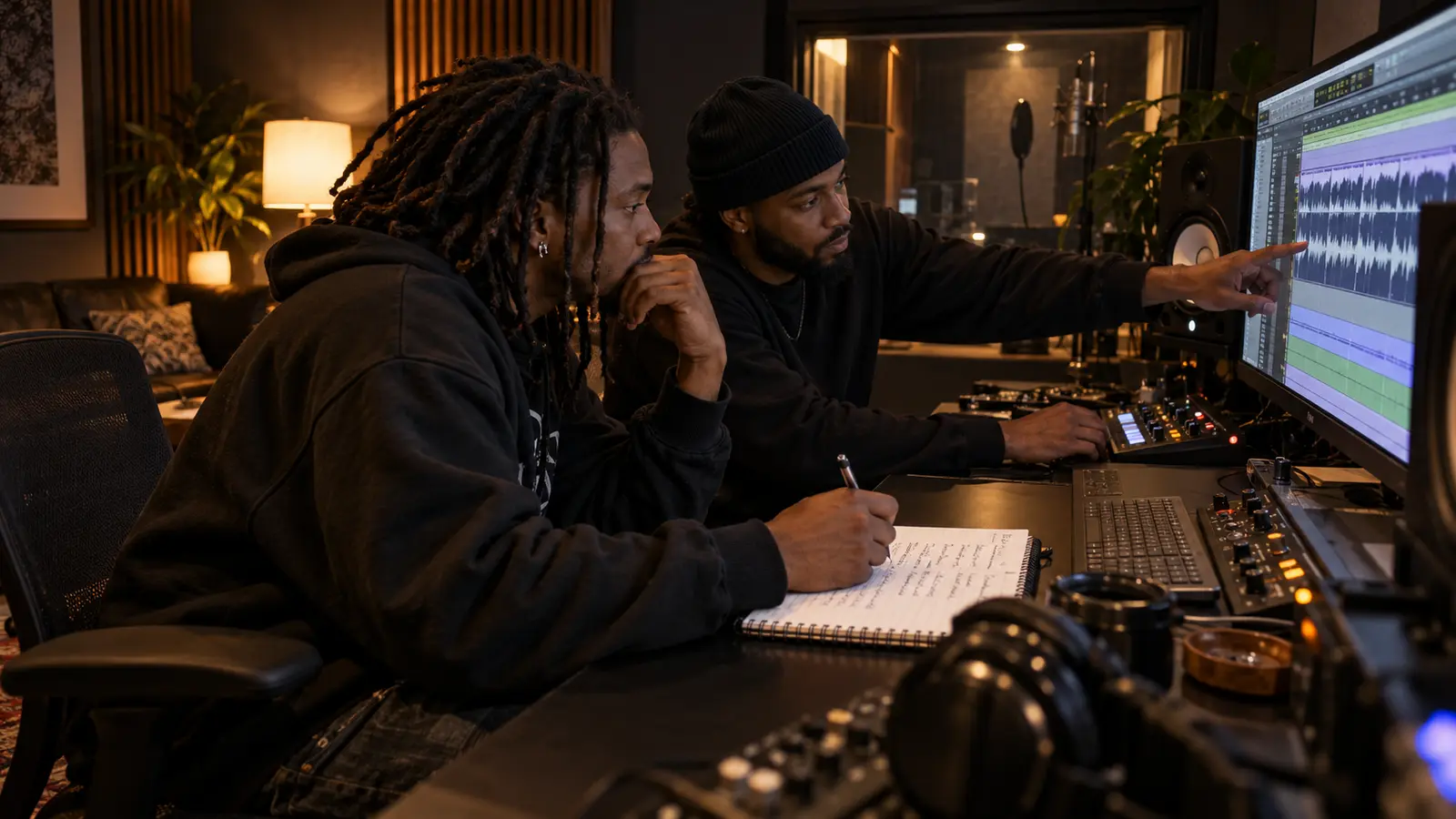
“Make it hit harder” describes a reaction, not a repair. An engineer still needs to know which moment feels weak, what you hear, and what should remain unchanged. Good revision notes make those decisions discussable without pretending the artist must know every technical solution.
This routine is an editorial workflow suggestion, not a universal studio rule. Agree on the engineer's preferred format, included revision rounds, delivery date, and approval process before sending a new list.
Name the exact mix
Put the artist, title, mix filename, revision number, and date at the top. Confirm everyone reviewed the same file. Notes for an old bounce can undo a change already made in a newer one.
Keep the approved reference and working versions separate using the recoverable project-archive routine. Do not rename a new export with an old filename and assume everyone will notice the difference.
Listen once without writing
Hear the complete song at a comfortable level before stopping every few seconds. Note the overall balance, emotional movement, intelligibility of the lead, and whether the ending feels intentional. A tiny sound can become disproportionately important when it is the only thing you have replayed.
Then check a small number of familiar listening setups. Describe the setup when a concern appears only there. “The hook vocal is difficult to follow on my phone speaker” gives the engineer more context than “the vocal is wrong everywhere.” Our everyday-speaker mix check offers a repeatable comparison.
Separate observation from proposed solution
Write what you hear first. At 1:12, the last word of the verse disappears behind the ad-lib. Your desired result is that the sentence remains understandable. Turning the ad-lib down may help, but the engineer might find another solution that better preserves the performance.
Label a specific production request as a request: “Could we try a shorter delay here?” Do not disguise a personal preference as a technical defect. Equally, identify a click, missing word, wrong edit, or unintended silence plainly rather than burying it in taste language.
Use four fields for each note
- Location: timestamp, section, and identifying lyric or instrument.
- Observation: what you can actually hear.
- Desired result: what the listener should understand or feel.
- Priority: essential correction, important balance decision, or optional experiment.
For example: “0:48, first hook: the response vocal masks the lead's final word. Keep the exchange energetic while making that word clear. Important balance decision.” This is an invented example, not a report about a particular artist's recording.
Protect the parts that already work
Include a short keep list: the verse intimacy, the kick's relationship to the bass, or the final harmony's width. A revision brief should explain the boundaries of the change, not just the dissatisfaction.
When several voices trade lines, use the call-and-response listening exercise to identify which voice begins the exchange and which answers. Ask for a clearer relationship rather than treating every background part as unnecessary clutter.
Combine the team's feedback
Choose one person to consolidate comments. Resolve contradictions before the engineer receives them: one collaborator may want the vocal more exposed while another wants it further inside the beat. Sending both without a decision transfers an unresolved creative disagreement to the mix desk.
Keep new arrangement, writing, and performance requests separate from mix corrections. Replacing a verse or rebuilding a hook may change the scope and schedule. Ask first rather than assuming every creative change belongs inside the same revision round.
Close the loop on the next bounce
Review each requested change in context, then hear the whole song again. Mark notes resolved, still open, or intentionally withdrawn. Approve a named version in writing and preserve that record with the delivery files.
Before sending the approved result outside the team, use the listening-link preflight to check the recipient's actual route into the music. General workflow questions can go to the reviewed artist forum without private files or contact details. Find more studio guidance in The Signal.
Press Play above to hear IHHR or visit the official Live365 station page.